 Lenka's Way of Lace
Time to Grow
Posted on April 22, 2024
April 22, 2024
Spring is a wonderful season. Watching the nature waking up and making the most amazing shapes and colours seemingly out of nothing is the best inspiration for creative souls.
It never fails to fill me with awe and and urge to participate.

For many years now, my first spring project is the seedling, the simplest pattern that I ever designed. And I just can’t seem to grow out of it 🙂
I love leaf tallies in bobbin lace, and I love to make them in wire. The seedling is therefore an ideal pattern because it has nothing else than two leaves. The cotyledons are completed with the seed they originate from, and together they symbolize the new beginning, new life, new energy.
The seeds I like to use for the seedling are rudraksha seeds from India. Their name means “Tears of Shiva” and are considered to be auspicious and valuable as an instrument for inner transformation. The rudraksha seeds have been used for millennia as prayer beads. I found them in the Little India district in Vancouver where I used to browse and admire the traditional Indian arts and crafts. I always liked the shape and feel of the rudraksha seeds, even before I learned about their ancient history. They just looked like true seeds, and being round and wearable made them the best choice for the seedling pendant.
As I keep learning a little bit more about Indian spiritual traditions, I find it very interesting that in continuity of the ancient wisdom, a movement to Save Soil originated in India and is spreading around the world. It connects all aspects of environmental stewardship back to the health of the soil, and therefore has a potential to spearhead a real change. Because seedlings of any kind can germinate only in good soil.
Every year when the spring comes I make the seedling pendants. I like to wear them, too. More like a lucky charm than jewellery, especially when working in the garden, because in that field I am a complete amateur and need a lot of help from Mother Nature (the pendants are pretty hardy and can withstand a lot of wear and tear). Other seedlings get dispersed to family and friends with green thumbs, and sometimes strangers too, with an occasional overstock being donated to a local garden club’s annual plant sale/fundraiser.

To spread the seeds even further, the Seedling Pattern and Tutorial became available as part of Basic Series of my patterns for wire lace. Not that I expect there are many more lacemakers crazy about seedlings, but this simple design is truly good for practicing those leaf tallies!
Spring is in full swing, and if you feel like growing some plants, or lacemaking skills, give the Seedling a try!

Happy lacemaking to you all 🙂
Year of the Wood Dragon
Posted on February 10, 2024
February 10, 2024
Living and working in a truly multicultural place (Metro Vancouver, Canada) we are lucky to learn and experience traditions that people from all around the world brought with them to their adoptive country. Chinese New Year celebration is one such example, a joyous and vibrant tradition that survived millennia of turbulent evolution. Based on a lunisolar calendar, a complex system combining earthly and universal events, the ancient Chinese visionaries attributed certain qualities to each year and predicted their influence on people at many levels, from spiritual to material.
Yesterday’s New Moon ushered in the Year of the Wood Dragon.
* The Dragon is a majestic creature in Chinese folklore, symbolizing bravery, creativity and innovation. Dragon people (those who were born in a Year of Dragon) are charismatic, ambitious, adventurous and fearless. They have confidence and independence, and are not afraid to pursue their dreams.
Therefore, the Year of the Dragon in 2024 is expected to be a time of visionary leaders and problem solvers. It is also predicted to be a great year to start new projects and explore new opportunities.
In the Year of the Wood Dragon 2024, the fixed element of the Dragon is Earth, which represents stability, honesty and loyalty. The variable element is Yang Wood, which represents growth, vision and flexibility.
The rare combination of the dragon’s power and the wood’s creativity brings a potential to pursue one’s dreams, express ideas and expand horizons. It is also a year to be generous, compassionate and inspired.*
What more can we wish for?

I like the sky roaming dragons so much that I even made one in lace. Envisioned as a wild wearable piece, it took a life of its own and eventually found a place in my friends’ eclectic art collection. After they had it properly mounted by a master framer, I was really surprised how the Dragon came alive in the custom setting. And pleased to know that it did not fly too far away from me!
Thank you, Lulu and BP, I remain grateful for your patronage 🙂

I look forward to a full year of creative energy and can’t wait to see what the Wood Dragon brings to the world, and to art of lace in particular!
*Source: https://www.thechinesezodiac.org/year-of-the-dragon/
Divine Harmony: Offering to Mother Earth and Father Sun
Posted on November 19, 2023
November 19, 2023
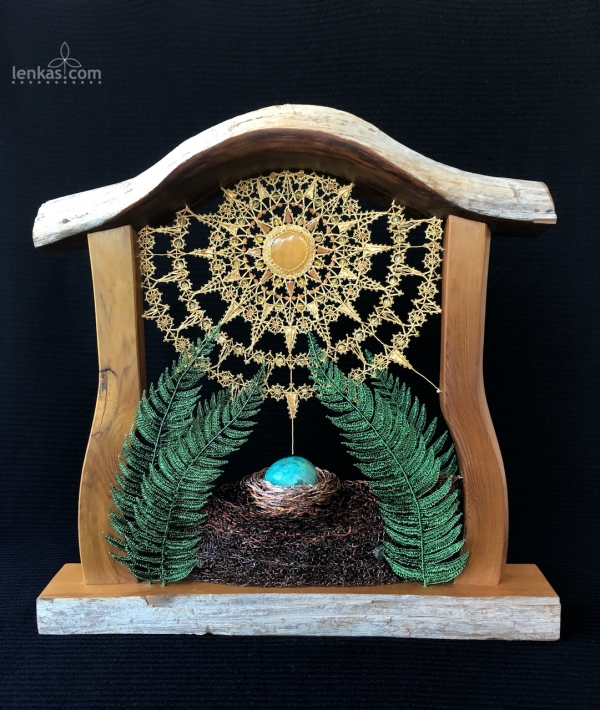
Frame:
Reclaimed red cedar – designed and made by Colin Hamilton of Thuja Wood Art
Handmade Bobbin Lace:
Enamelled copper wire, silk, wool
Semi-precious stones and beads:
Chrysocolla, Calcite, Citrine, Aventurine, Sunstone, Garnet, Serpentine, Quartz
Dimensions in centimetres: h:50 x w:50 x d:10
Dimensions in inches: h:20 x w:20x d:4
~
This work completes a series of offerings dedicated to the magnificent Nature, in a creative collaboration with Colin Hamilton of Thuja Wood Art. Colin’s work is deeply rooted in the West Coast tradition, while my metal bobbin lace evolved from centuries old European craft. Unexpected meeting of two very different disciplines resulted in a unique, one-of-a-kind body of work: ‘Offering to the Tree of Life’ (2015), ‘Waves: Offering to the Moon’ (2015), ‘West Coast Mandala’ (2017), ‘Red Berries’ (2019), and finally, the ‘Divine Harmony’ (2023).
It took a long time to bring the last work to fruition. When Colin delivered the frames, one in particular caught my attention. It had a strong base and arch that seemed to protect a womb-like inner space. Raw edge on the outside contrasted beautifully with finished wood, in colour as well as texture. Overall, the frame was so well balanced, and so inviting, that I thought right then that it will become a special piece.
As time went by, one by one the wood/lace sculptures were completed and sent off to the world. The last frame seemed content sitting empty on my studio bench. I imagined that the wood must have been from a tree that lived a long life, then drifted in the Pacific ocean to reach Gulf Islands, dried on the beach there, and waited for Colin to salvage it and use the reclaimed wood for the frame. What a couple of years could mean in its life cycle? That perspective gave me freedom to wait for the right idea. Because the simplest things are sometimes the most difficult to express in art.

On New Year’s Day 2020 I took a photo while strolling in an urban forest in my neighbourhood. It was a peaceful day, ideal for contemplation. Admiring nature’s contentment and ability to maintain equilibrium regardless of season, weather or time, I wondered if it is possible for a man to live that way, too – in balance, instead of struggling in self-created chaos. The serene moment became an inspiration for the final Offering.
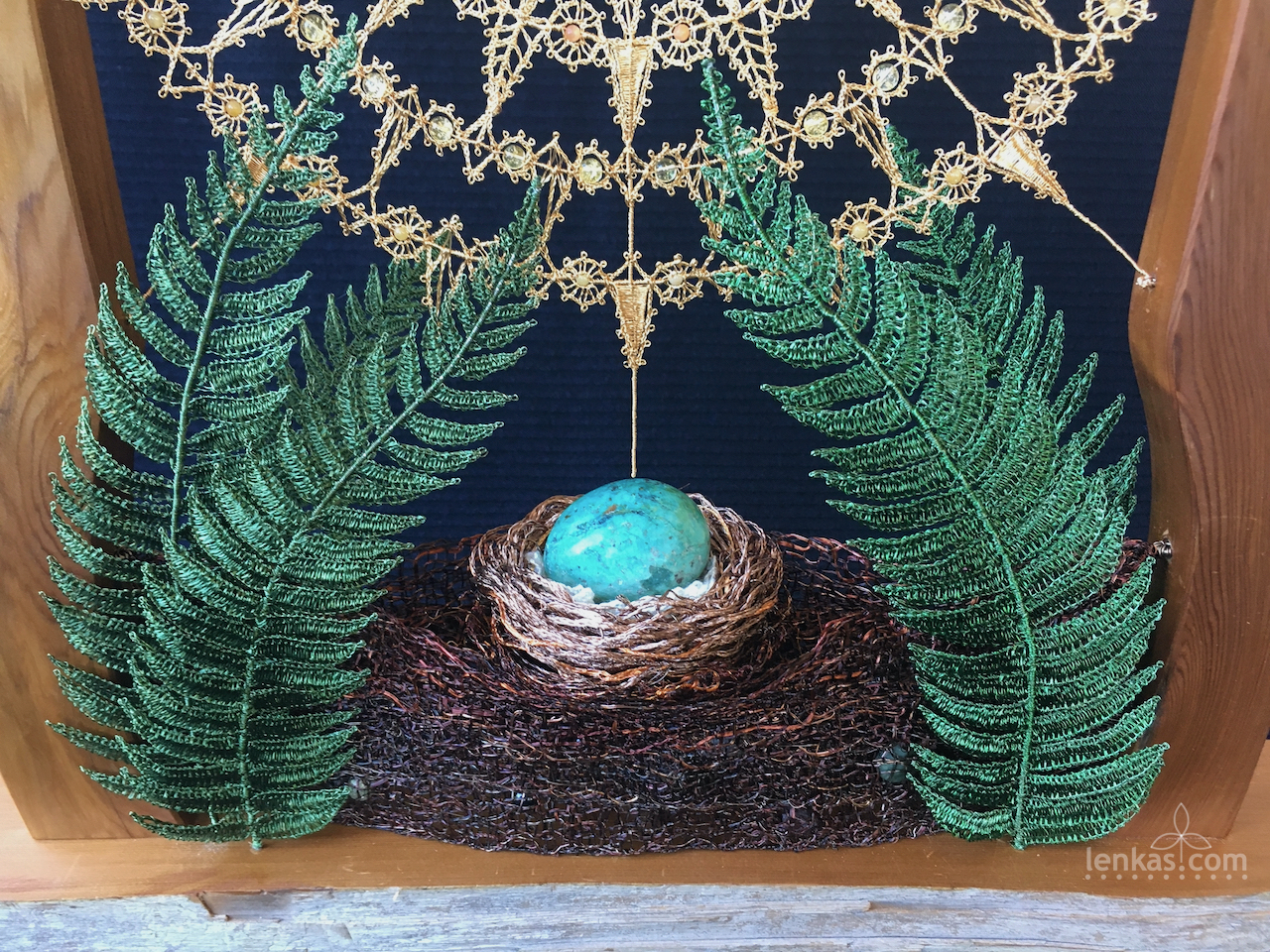
‘Divine Harmony: Offering to Mother Earth and Father Sun’ is a tribute to the two forces that permeate all that is, on our planet and in the whole universe.
Called by Indigenous North Americans Father Sun/Sky and Mother Earth, and in many cultures by other names – Shiva and Shakti, Yin and Yang, Pachamama and Inti, the Creative and the Receptive, Ida and Pingala, Masculine and Feminine – they are the two fundamental energies which exist and work together. They are of opposing qualities, but not antagonist. Being different, they compliment and complete each other. When they are in balance, life happens.
As my time for lacemaking became limited due to unprecedented circumstances, the months working on the “Divine Harmony” turned into years. Despite the slow progress, or maybe because of it, I enjoyed every moment at my drafting table and lacemaking pillow. Lost in lace and in space, I learned a lot about the fine lace craft, and even more about myself and the source of my profound need for balance and tranquility.
Mother Earth
Starting form the ground…
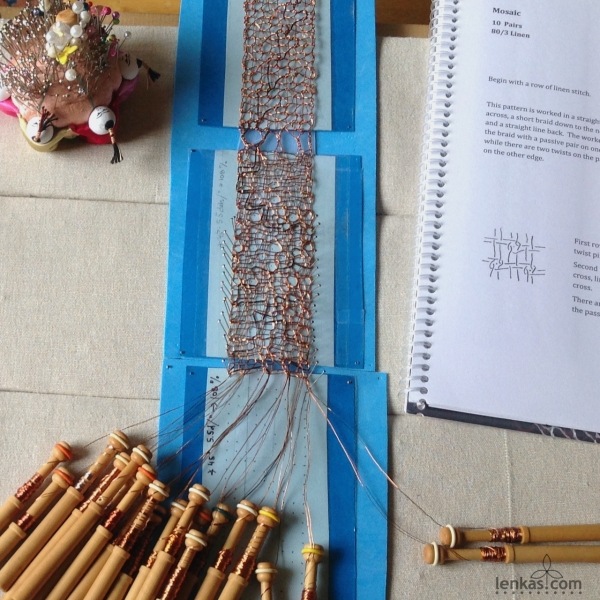
The Earth’s strength lies in the ground, and there is nothing more important than the soil cover. It holds all resources for life to flourish. Everything grows from the soil and returns to the soil in an infinite cycle. Soil is the most amazing complex of organic and inorganic matter living in total synergy, hidden under the surface, yet influencing everything above. I was looking for a pattern that is structured yet fluid, like a weave of roots, and I found it in an experimental and very interesting book ‘Using Modern Grounds’ by Michèle Kelly.
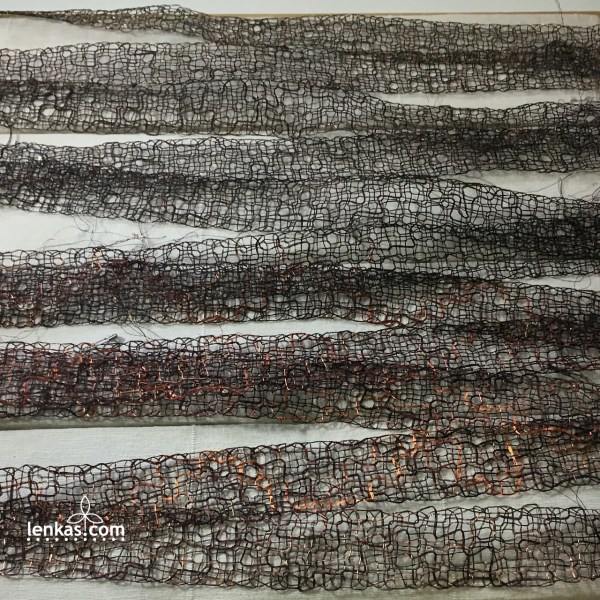
The Mosaic pattern was fun to make and allowed me to play with texture and colours. Mixing black and brown wires in multiple strands of three to six ply in random order produced an organic texture in variegated colours that were changing along the length of the lace. Once the pattern was committed to memory the work became pleasantly rhythmic, with bobbins flowing and gently clicking. Unlike traditional lace grounds, this pattern is worked in horizontal rows. Wire provided good support the open structure, so I was able to omit the interior pinholes and place pins only at the foot sides, which sped up the work considerably. Six yards were needed for building a strong ground foundation of the sculpture. The work on this pattern was so pleasant that I almost regretted reaching the required length rather quickly.
The finished yardage was folded and shaped to create a dense soil. Between the layers, I enclosed a handful of raw semi-precious stones (garnet, citrine, serpentine and quartz). While the minerals are hardly noticeable in the dense weave, their presence grounds the earth and infuses it with strong energy patterns.
In the centre of the soil a shallow recess was prepared for the nest.


Growing ferns…
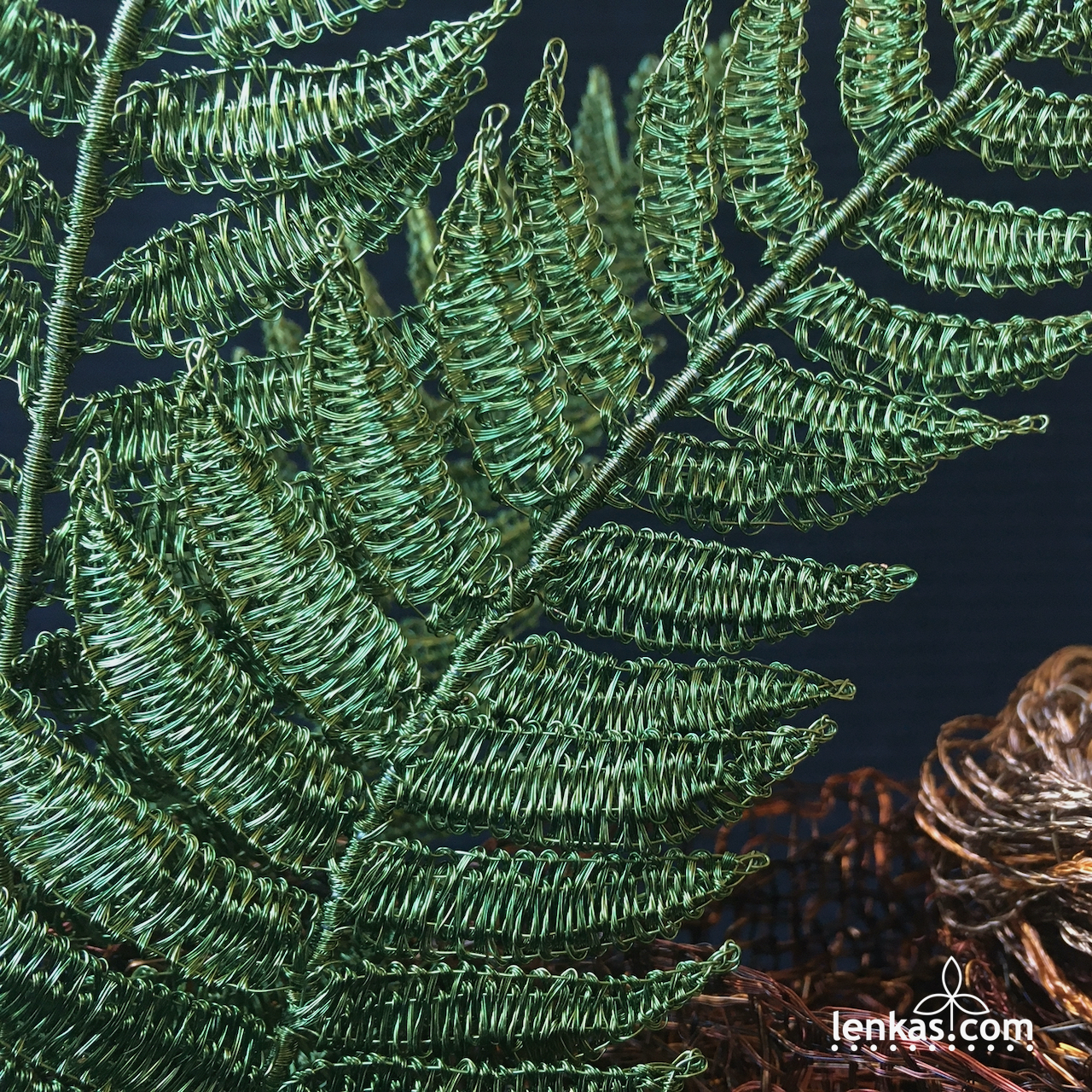
Coastal Mountains forests are full of ferns. A diverse species of ancient origin, these plants thrive in our humid climate and grow everywhere, gracing the landscape with cascades of fronds in many shapes and shades of green. Despite not producing flowers, ferns are very beautiful, ornamental, and prolific. Many stay lush all year around and provide microhabitat for various other plants as well as animals.
Fern leaves made in wire are an attestation to the potential of free style lace design. With just four pairs of bobbins, and a lot of patience, the lace fern grows and unfurls, one leaf at a time. This very slow process leads not only to a total tactile and cerebral satisfaction but also to deep appreciation of all Earth’s creation. In the Offering, the ferns play an important role of providing a protected space for a new life.


Building nest …
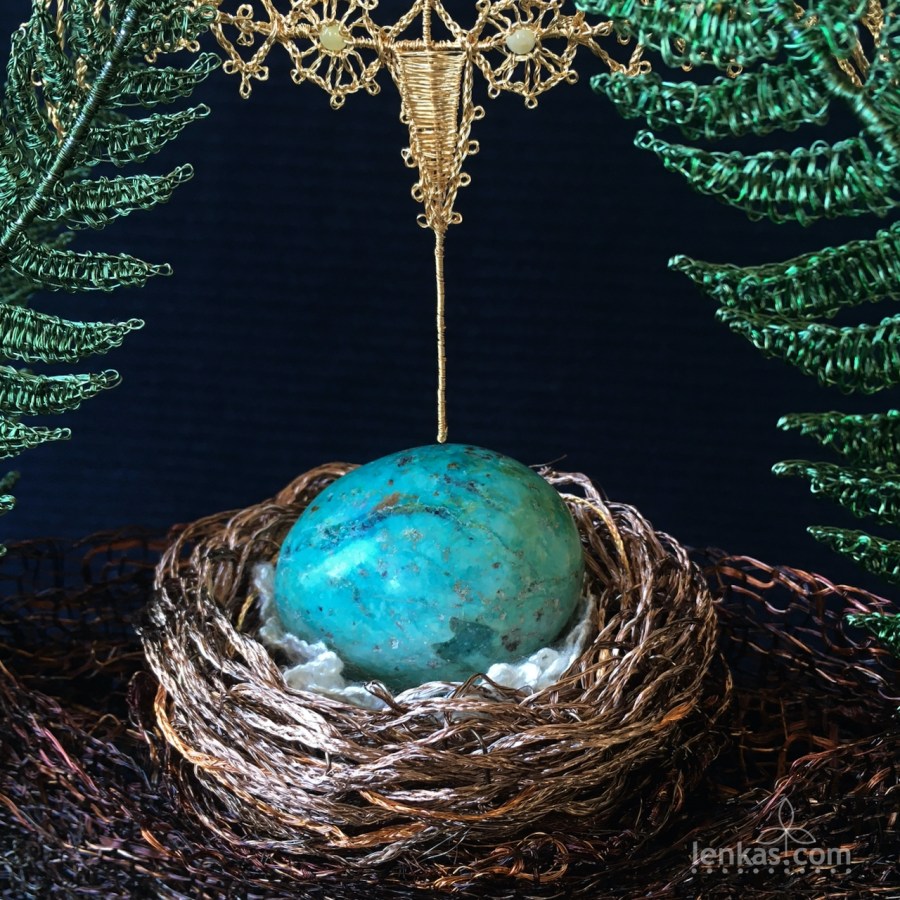
With the foundation laid, it is only a matter of time for a nest to be built. As opposed to real nests made by birds, the expert builders with highly specialized skills, mine was pretty simple, constructed from long plaits, wound and interwoven together. To make it more welcoming, I lined the bottom of the nest with lace made from wool and silk fibres.

Father Sun
Temperate rainforests of the Pacific Northwest are humid and cool. When the sun penetrates a dense tree canopy, its warm rays are received with deep reverence by the earth, animals and people. Sun is precious, and therefore worshiped as the vital force.
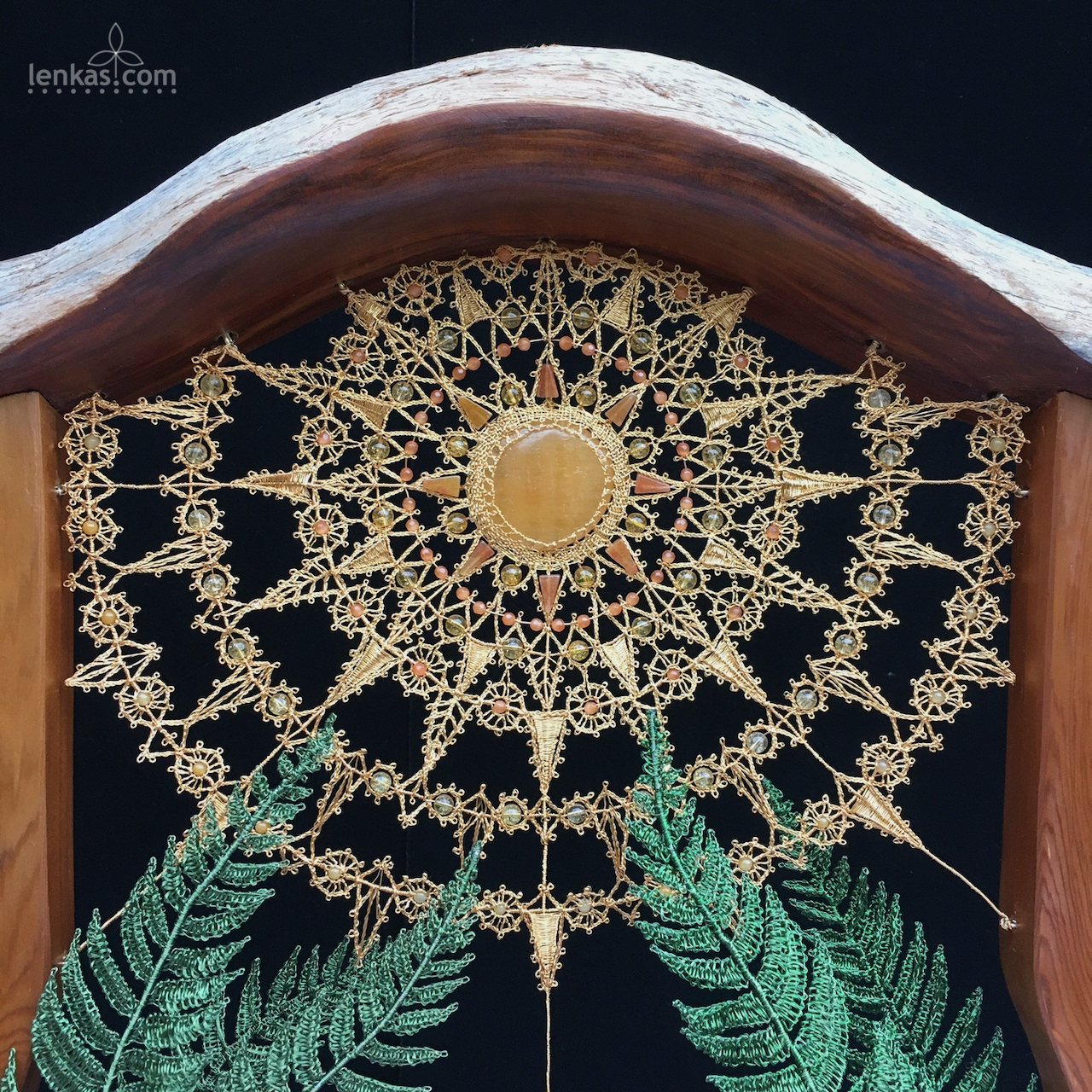
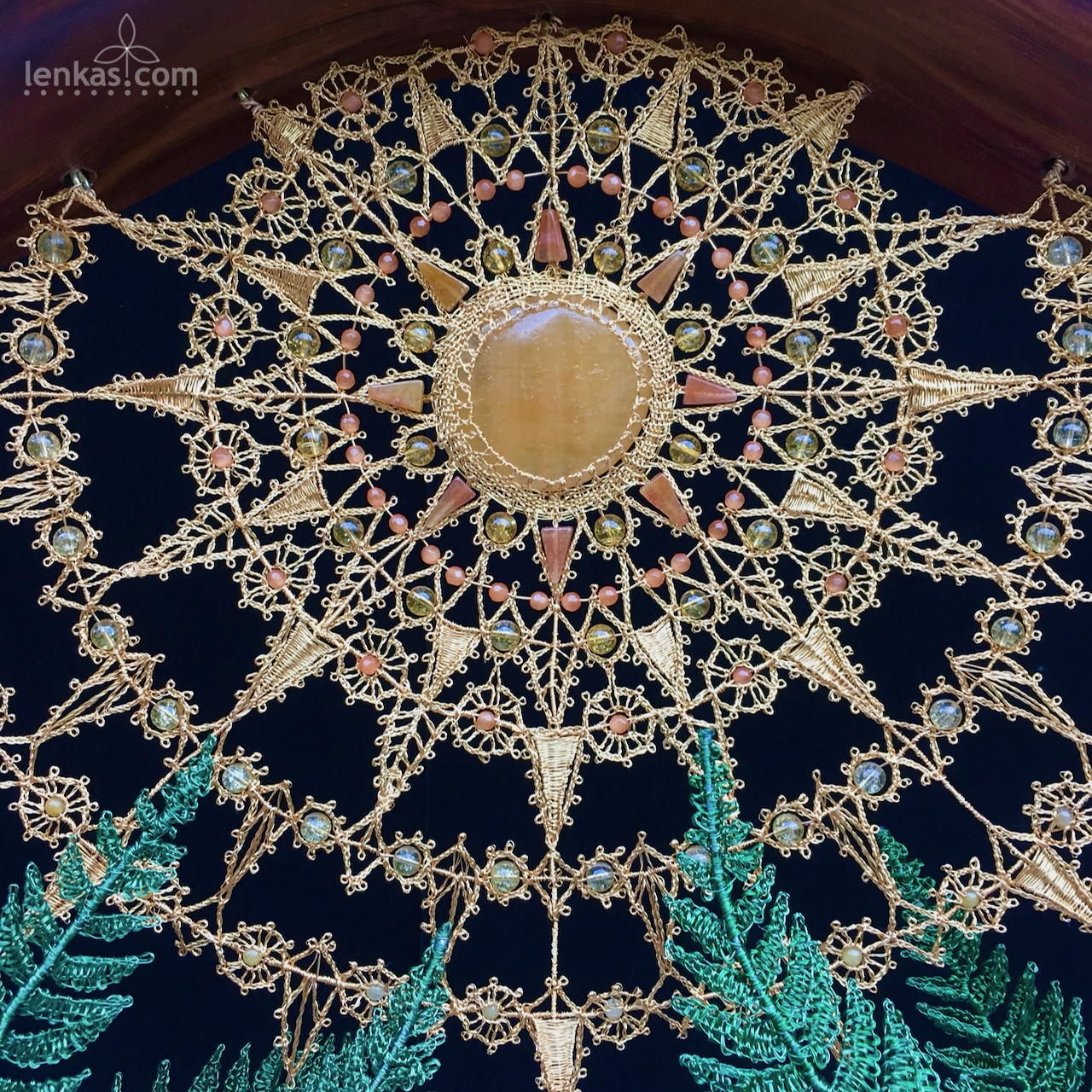
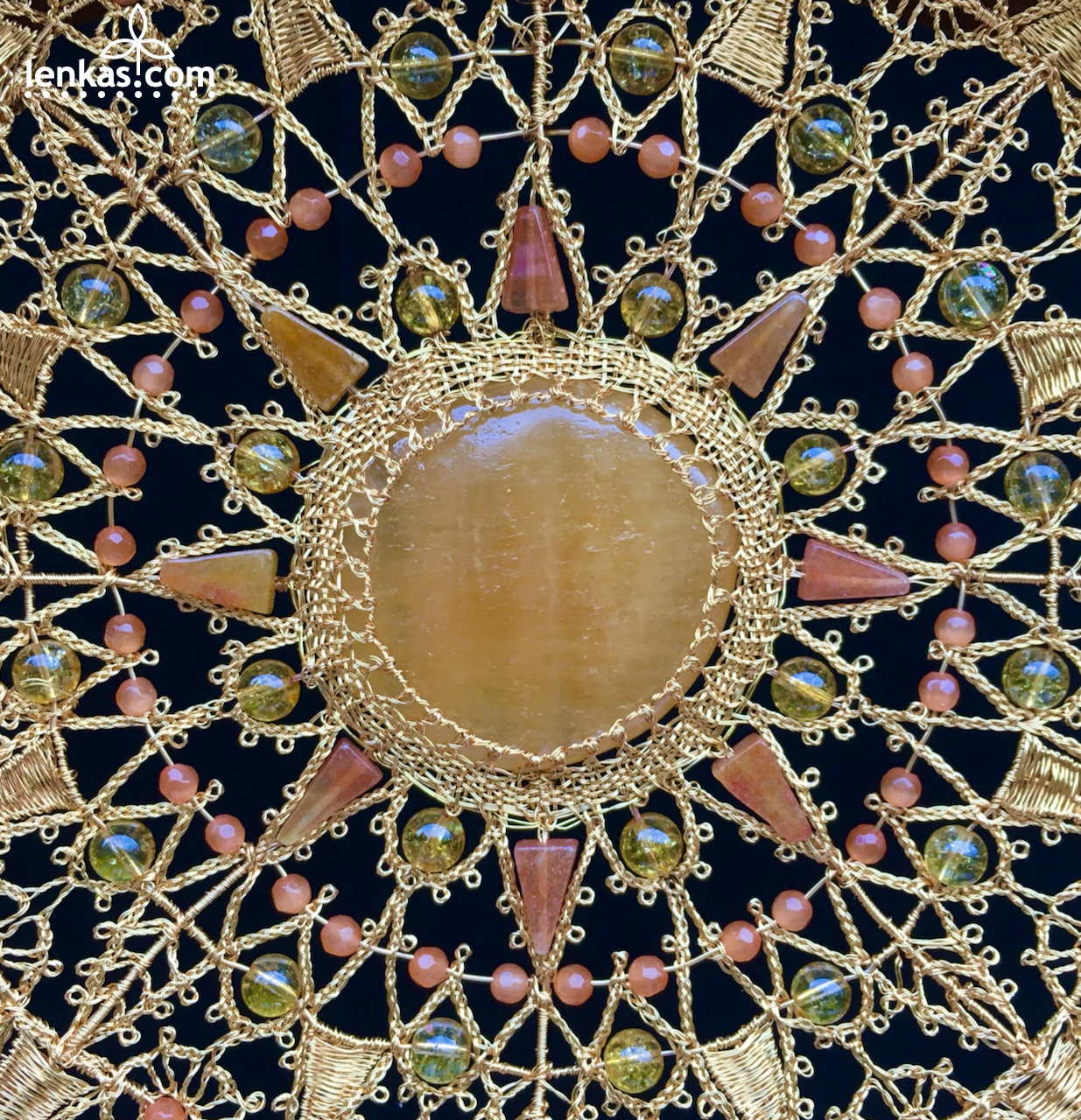
How to express a venerated sun in the language of lace? I reached deep back in time to the old Italian tradition. Originated in the Renaissance, plaited laces of Venice and Genoa epitomize the spirit of an exceptionally fertile historical period. Art and science then merged in a great creative surge and propelled Europe from medieval to modern era. Five centuries old Italian designs have lost nothing of their beauty and vitality, and today they lend themselves exceptionally well to the wire medium. I love their geometrical patterns of plaits and tallies, and their fearless expansion into empty space. They seem to be made for wire and I couldn’t envision a better form for the Sun.


Natural calcite, citrin, aventurine and sunstone enhanced the gold colour copper wires to represent qualities of the creative force: power, light, potentiality. The sacred geometry inherent in the pattern directs the energy from its source out, through waves of concentric circles and along the sun rays stretching towards the Earth.
New Life
When Father Sun reaches the receptive Mother Earth, a miracle of life happens.
Symbolized by a chrysocolla egg, the new life originates from both fundamental energies: the creative and the receptive, light and dark, masculine and feminine, the cosmic and the earthly. Therefore, it is complete, perfect and faultless.
It is humbling and at the same time uplifting to realize that humanity has the same origin.
I offer the ‘Divine Harmony’ with heartfelt gratitude to the Mother Earth and Father Sun for their boundless, immeasurable Love. With each sunrise we are given a new chance to witness their magnificent creation and through it comprehend Life and Truth.
I believe that without such introspection humanity cannot solve current problems and conflicts, and The ‘Divine Harmony’ is my prayer to bring forth the fundamental law and honour the dignity and possibility of our existence.


I am grateful for being able to realize this work despite the challenging times, and thus completing the latest chapter of my lacemaking journey.
Thank you for reading this very long post. If you find it worthwhile, please share with your friends.
Lenka
June Solstice 2022
Posted on June 21, 2022
The summer season is officially here and summer weather is apparently on time, arriving in Vancouver this weekend. Finally! It’s been a long wait for the bright and warm sunshine.
I plan to continue working on a lace sculpture for the last red cedar driftwood frame from Colin Hamilton of Thuja Wood Art. Colin and I have collaborated on four sculptures so far, with Colin designing the original frames allowing me fill them with metal lace. It’s been a very special project which inspired me to take the lace art into new territory. Most of my previous works had been firmly connected to great European tradition that started five hundred years ago and carried the Renaissance ideals of beauty and harmony of material and spiritual dimensions of human existence.
Colin’s unusual creations reflecting his deep connection to the West Coast nature, invited me to traverse the big divide and use my beloved technique to manifest a completely different energy. It was quite an amazing experience seeing each piece taking shape reminiscent of nature and it’s cycles, while using symbols similar to the ancient cultures of North America.
I talked about it with my friend, an artist who – like many creative people on this continent – had been struggling to find an original expression in the seemingly irreconcilable influences in the modern Canadian society. She listened and simply said, “You have arrived.” We both knew that this “arrival” happened twenty years after I actually landed. Some things just take long, very long time… And they are well worth the wait.
Thus the last frame from Colin’s original batch have been sitting in my studio, year after year, standing by patiently. It happens to be my favourite driftwood frame, because it is shaped as a womb that holds a sacred feminine energy. About two years ago, after a substantial gestation period an image of a new work has taken shape, and slowly, very slowly I started to work on the lace. I dedicated the previous winter to fern design, and after that I submerged for almost an entire year to explore the depths of the soil.

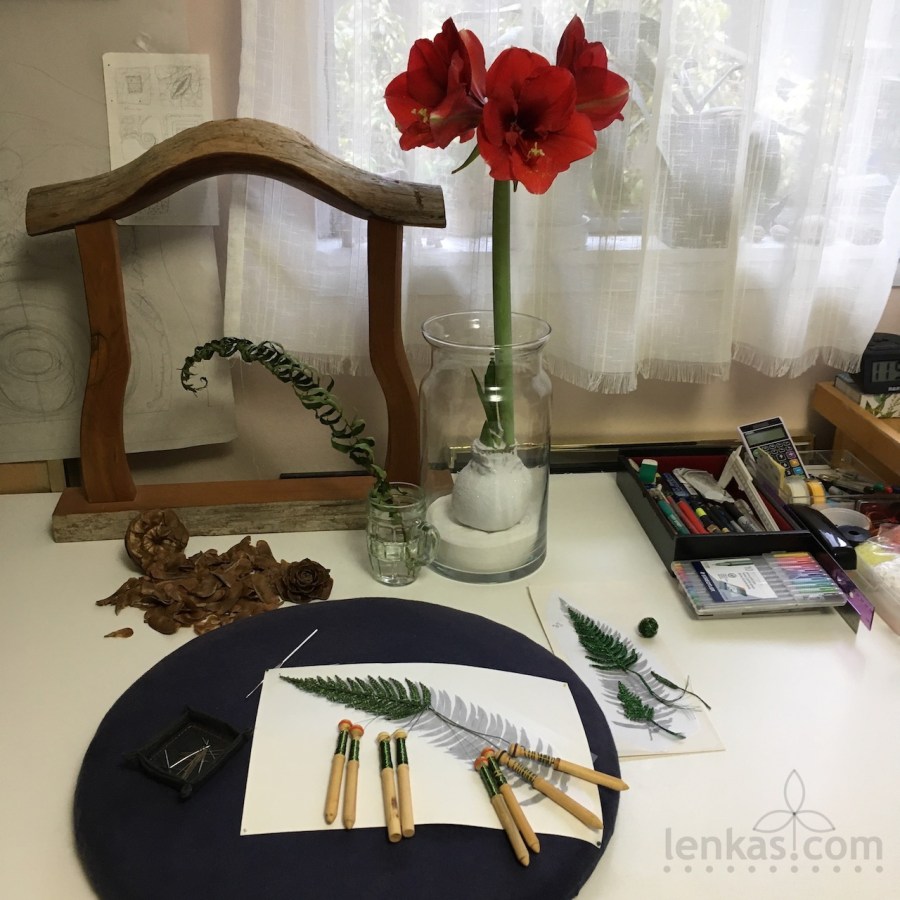

Today’s Solstice, marking another zenith of the Sun, is bringing me closer to completing the piece. All it needs now is the power of the Father Sun to unite the earth and heaven in a sublime harmony… Humbly, I will follow, working on long summer days, absorbing the life-giving energy, and rearranging it into a radiant lace pattern. Hopefully, with Sun’s blessing, I will be able to carry out the work to live up to the image in my mind’s eye. If it’s successfull, I will share it with you.

Wishing you all wonderfully creative summer!
And equally amazing winter to all lacemakers in Southern Hemisphere, because each season can bring something new if we are attuned…
Happy lacemaking to all!
Offering: Red Berries
Posted on March 26, 2019

Frame:
Cedar driftwood (designed and made by Colin Hamilton of Thuja Wood Art
Lace:
Enamelled copper and stainless steel wires
Semi-precious stones and beads:
Bamboo Coral, Clear Quartz Crystal, Hawk’s Eye, Rudraksha Seeds
Technique: handmade bobbin lace – TesseLace pattern
Dimensions in centimetres: h:43 x w:43 x d:5
Dimensions in inches: h:17 x w:18 x d:2
If cold winter months are good for something else than hibernating, it is for lacemaking. Long, dark nights offer quiet time for uninterrupted work and allow sustained focus that reaches almost a state of meditation.
Cocooning in my studio, I was looking for an idea for lace that would fit in one of Colin’s driftwood frames. Dried by sun and fresh air the wood feels so warm, as it is radiating energy collected over many summers. Just like standing cedar trees, the driftwood offers assurance that we, too, will survive yet another winter. Living on the West Coast of Canada for thirty years, I came to understand why cedar has been considered sacred by indigenous people.

majestic cedar tree in my backyard
An empty red cedar driftwood frame has been standing on the shelf in my studio for more than a year, patiently waiting for lace. Upon invitation, the images kept appearing, but none of them strong enough to stay and prompt me into action. One day, on a walk through fresh snow in Kwomais Point Park, I was amazed by dark lines of underbrush with embellishments of ice and red berries, set starkly against pristine white background. There is a lot of lace to be found in the forest, but rarely in such plain sight.


I started to work on my next offering. Once again, my connection with Veronika Irvine and her TesseLace worked miracles, and I was able to find the right grid and use the Circular Grid Templates for designing the mandala.


It worked so well that the piece was finished before the snow in the forest melted… It became my offering to the season that makes us revere cedar, to the beauty of snow and ice, and to the berries who know how to say ‘fertility’ like no other.


The Offering: Red Berries will be shown in juried exhibition ‘Just Gates’, organized by Arts Council of Surrey, in April 2019.
Copyright©2019. Lenka Suchanek. All rights reserved.
Meganeura
Posted on September 14, 2018

Material:
stainless steel and enamelled copper wires
drift wood, crystal beads
Technique: handmade bobbin lace – free form
Dimensions: 48 x 72 x 5 cm (19 X 28 x 2 in)
Meganeura is an offering to Gaia and her transformative powers.
Meganeura, a dragonfly’s ancestor from the Carboniferous period, symbolizes transformation, survival, and incredible ability of Earth creatures to adapt and evolve with the environment. Watching dragonflies and knowing that their progenitor Meganeura lived 300 milion years ago, always fills me with awe and reverence for this planet and all life it carries.
This offering is a prayer for us, people of this Earth, to listen to Gaia, and learn from her wisdom… before it is too late.


Copyright©2018. Lenka Suchanek. All rights reserved.
Offering: West Coast Mandala
Posted on November 14, 2017
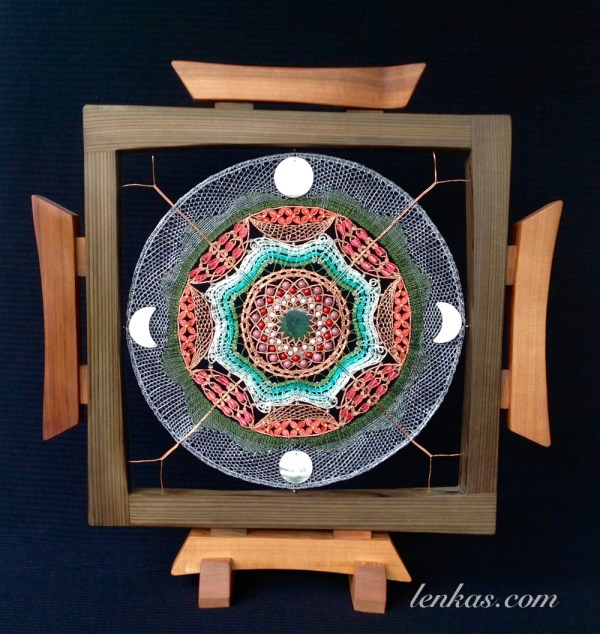
Frame:
Cedar driftwood (designed and made by Colin Hamilton of Thuja Wood Art)
Lace:
Enamelled copper and stainless steel wires
Semi-precious stone cabochons and beads (from centre):
Nephrite (BC jade), Almandine Garnet, Shell, Rose Quartz, Bamboo Coral, Rhodochrosite, Clear Quartz Crystal, Calcite, Blue Tiger’s Eye, Shell, Hematite
Technique: handmade bobbin lace – free form
Dimensions in centimetres: 64 x 61 x 12 ( 4 cm without stands)
Dimensions in inches: 25 x 24 x 5 (2 inches without stands)
West Coast Mandala is an Offering to the magnificent Pacific Northwest nature.
In harsh climate of the temperate rainforest, human life has never been easy. Ancient people called upon spirit powers to receive guidance and protection. They were taught to live in harmony with the land and the ocean, and respect all plants and animals. This wise, timeless teaching still resonates on the West Coast.
The Offering: West Coast Mandala is presented in a frame made from red cedar driftwood, which carries the spirit of the tree of life, and creates a sacred space for reflection and meditation. In its centre, the mandala holds a cabochon of the B.C. jade, and radiates the energy outwards through the copper wire weave. Inner sacred geometry circle with semi-precious stones, coral and shell beads, represents the earth’s depths. Surrounding three currents symbolize underground, surface and ocean water bodies. Water brings fertility and abundance to the soil and to people, and they present offerings of flowers and fish. Fertile land is encircled by a protective range of the coastal mountains, which merge into the mist of the sky dome. From above, water motion, vegetation growth and people’s lives are governed by the moon cycle. All is connected and therefore in harmony with the timeless wisdom.
This artwork is now exhibited in Talisman Gallery on Pender Island, BC.
Copyright©2018. Lenka Suchanek. All rights reserved.
Making handmade lace art
Posted on November 12, 2017
(How much time does it take?)
Handmade lace art form is not very common in Canada. Whenever I exhibit or demonstrate lacemaking for public, many visitors comment that they have never seen anything like it before. And then comes a standard question: “How much time did it take to make this piece?”
I never know what to say, because I do not keep track of hours when I create. To answer, I usually estimate the number of hours, days, weeks or months that I spent on the project, with a postscript “…and thirty years of experience…”
Lacemaking is an old craft, that preceded invention of an electric power transmission by some 400 years, so there is a lot of manual labour involved in each step of the process. I thought it might be a good idea to explain here what is involved in making lace art, so I can refer any future inquirers to this post.
For this purpose, I chose to document a simpler project, a wall art piece “Offering: Moon Reflection”, as not to overwhelm the readers. Each step of the process is described below, followed by and approximate time count.
Step 1/ Finding a frame
Starting with a frame is simpler for me than creating the lace and then trying to find the right frame for it. I search for empty frames that invoke lace picture, or imagine the lace and then look for the right frame. When I saw this frame, I liked it, but did not buy. As I kept thinking about it, an image of a reflecting moon became clearer and clearer. Eventually, I went back for the frame. It would sit in my studio for a half a year until I had time to make the “Offering”.
(3 hours)
 Step 2/ Making a sketch
Drawing the image on paper is quick. Shown here is the small sketch with notes and some calculations of the future lace pattern.
(30 minutes)
 Step 3/ Choosing a pattern
Having a basic idea about shape and texture of the lace, I look for a pattern which fulfills the visual as well as structural demands of the piece. In this case, I needed rather simple two-dimensional lace in one colour. I envisioned only one pattern, but with a special requirement that it can be graded without losing continuity. To create an image of a water surface, I chose not to use a traditional lace pattern, but rather look for new, unique design with somewhat wavy effect. Perusing Veronika Irvine’s TesseLace, algorithmically designed lace tessellations, available as an Inkscape Bobbin Lace Application (courtesy of Veronika Irvine, tesselace.com), I selected a pattern number 4x4_217 and drafted a set of ten scaled grids. Using a computer program to create these grids is an enormous help to a lace designer, as it requires only a fragment of time that would be otherwise needed if the patterns were all drafted by hand.
(3 hrs)
 4/ Making lace samples
To make sure that the pattern will work, it is the best to make a sample. I used bobbins that were already wound (leftovers from a previous project) and made several swatches. The TesseLace grid is just an outline, showing the paths of the threads in lace. There is an unlimited number of stitch combinations that can be applied to that grid. I tried several options, from which the final design was chosen. This part of work is quite experimental, because even a slight adjustment of stitches can dramatically change the look of lace. Here the designer must rely on experience and also practice restraint, in order to avoid lengthy excursions into the amazing lace wonderland. There many ways to interpret one grid, and I had to decide for just one of them.
(6 hrs)
5/ Making pattern corrections
Comparing the samples revealed that the pattern in small size was right, but the enlarged size was too open, so I went back to the drafting program and used different parameters for scaling the grid. It took some fiddling to finalize grids for all ten segments of lace. My printer was not working smoothly that day, so this step took longer than it should.
(3 hours)
 6/ Preparing working templates (prickings)
In this standard procedure, the printed pattern is attached to a card stock, and covered with a clear plastic sheet. This working template, called a pricking, is then perforated with a pin vise at all cross points of the design. At each hole, a pin will be inserted to support wires during the lacemaking process. Therefore the final look of the finished lace largely depends on the template precision. Knowing that this pricking will be used only once (because this piece will be a one-of-a-kind original, made only once) I used a backing of a lighter card stock, which is easier and therefore faster to perforate.
(3 hours)
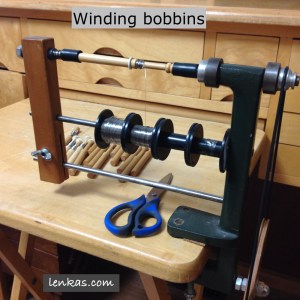 7/ Winding the bobbins
Using just one size and type of wire in this project (stainless steel 0.2mm), the process of winding was straightforward. Because the lace was designed in ten strips, which will be connected together to cover the final width, only 18 pairs (36 pieces) of medium bobbins for wire lace were needed. I used my old mechanical bobbin winder to fill all bobbins with 2-ply of steel wire.
(2 hours)
8/ Making lace
The slowest, most laborious, and most time consuming, and also the most enjoyable part or the work is making the lace. Stitches are created one at the time, by twisting and crossing the threads in an exact sequence. At certain points, pins are placed in the pre-pricked holes. The pins hold the stitches and facilitate tensioning of the wires. Steel wire is willful and a requires a firm tension to create an even weave. This makes working with steel slower than with other wires.
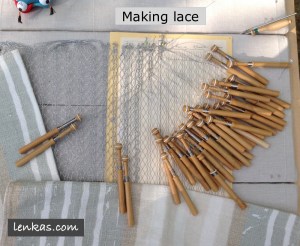 Work started at the first, narrowest pattern, and each consecutive segment was attached to the previous part by a special sewing technique.With this technique no additional assembly is required at the end.
(30 hrs – 3 hrs per segment x 10)
9/ Finishing lace
According to the design, all wire ends will be hidden under the frame, and therefore no special finishing was required. All ends were simply clipped off with wire cutters. Lace was checked for mistakes. Small errors were corrected, using a nudge tool and pliers. There was one big mistake caused by a wrong alignment of the prickings.. As soon as I spotted it it was sticking out from the pattern as a big irregularity. After much deliberation, I decided to leave the error in, as opposed to redoing the whole segment. The decision was rather atypical and defied my perfectionist tendencies, but as this lace represents ocean waves, which are fluid, free, and irregular, it seemed right to just leave it and let it be. Interestingly, as soon as I made this decision, the mistake was no longer so obvious.
(30 minutes)
10/ Preparing background
I chose a black silk fabric for the background, because it was as smooth and soft as a night sky. It always takes an extra bit of skill and time to stretch silk properly, but I feel it is worth the effort. Two milky marble cabochons, representing the moon and his reflection, were attached to the background.
(2 hours)
 11/ Mounting lace
This lace pattern had (as many bobbin lace patterns do) more twists than crosses, which, combined with willfulness of the stainless steel wire, caused the lace to curl. Therefore the finished lace had to be flattened before mounting. Then it was attached to a support frame. This extra inside frame will lift the lace slightly above the background surface, and give it a deeper perspective. It will also create a sufficient clearance for the lower cabochon.
(30 minutes)
12/ Beading
 Lace stretched on the support frame was ready for beading. I used seven kinds of beads to create an image of shimmering moonlight reflection in the water. For ease of working, I had the lace frame attached to a stretching board, but because of that I lost track of the background. When I checked, it did not look right. There were too many beads. I removed many rows and started all over. The second beading attempt was more successful and only a few small final touches were needed before it was finished.
(8 hours)
12/ Mat was measured and cut (30 minutes)
 13/ Framing
The whole piece was put together in a frame, hanging wire attached, back finished and signed.
(30 minutes)
14/ Photo documentation
The finished piece was photographed for documentation.
(30 minutes)
15/ Archiving
All drafts, prickings and working notes were compiled and archived for a future reference.
(1 hr)
Finished piece:
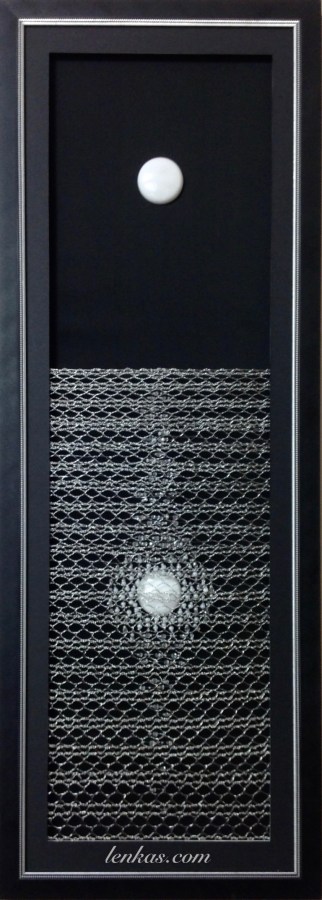
Title: Offering – Moon Reflection
Material:
steel wire, milky marble cabochons, glass seed beads, silk background
Techniques: handmade bobbin lace, beading
Size: 75 x 27 cm
Approximate total time: 64 hours (… and 30+ years of experience )
Copyright©2017 Lenka Suchanek. All rights reserved.
Waves: Offering to the Moon
Posted on May 12, 2017
“Waves – Offering to the Moon”

transparent lace sculpture
42 x 36 x 8 cm
driftwood redcedar frame, stainless steel, shell moon
Story of The Waves:
I was looking for frames for a new body of work, and I found Colin Hamilton, an artisan-woodworker, who works with cedar driftwood collected on the beaches of Gulf Islands. He hand splits the logs and builds gates, furniture and art, using traditional joinery techniques. Colin agreed to make some frames for me and I left it up to him to chose size and shape. The frames were beautiful when they arrived – very organic, and like no other frames I used before. They were already art pieces in their own right, and it was not difficult to see how they should be completed with lace. One small frame was asking for waves and I decided to use steel wire, because the Pacific Ocean on the Canadian West Coast often looks like it is made of steel. I couldn’t see though what pattern to use for lace, because all traditional lace designs lacked the fluidity I envisioned. I decided to create my own pattern, but since that takes long time, I put the piece on hold to let the design percolate. By chance, I was contacted by Veronika Irvine, a University of Victoria PhD candidate and a fibre artist, who developed a mathematical model to describe bobbin lace tessellations. From this model she generated thousands of original grid designs. Veronika was looking for lacemakers who would test the new patterns. I tried, and immediately realized that this was exactly what I wished for for my new piece – and much, much more…
I found pattern that flowed like water, made the “Waves” and offered them to the moon. The piece sailed away, spent some time on the Gulf Islands with Colin, then crossed The Strait of Georgia and reached Veronika’s lace collection in Victoria on Vancouver Island.
We regard the “Waves – offering to the Moon” to be a truly West Coast creation, in sync with the ocean waves that connect us. And while we are all busy with our own work, we are open to future collaborations. Colin is working on new frames (thujawoodart.com), Veronika is doing her binary code magic in computer science and lace design (tesselace.com). And I am leaving all the rest to the moon.


Copyright©2015-17. Lenka Suchanek. All rights reserved.
 Lenka's Way of Lace