 Lenka's Way of Lace
Year of the Fire Horse
Posted on February 26, 2026
February 2026
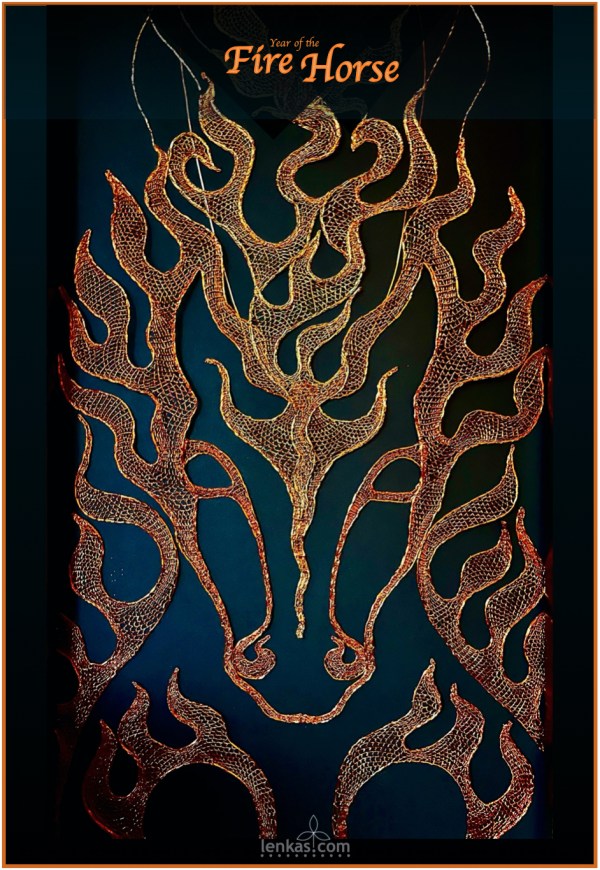
First time I heard about the Year of the Fire Horse was twenty years ago. In one of the chance encounters that make artistic life so interesting, I met a writer and a film director Julia Kwan, who was then promoting her new feature film “Eve and the Fire Horse”. A sweet and gentle story about a gifted nine-year-old girl growing up in a Chinese immigrant family in Vancouver opened hearts of local audiences, because it allowed us to see the challenges of our mixed multicultural society through the eyes of an innocent child. Eve used her wild imagination to process influences coming from all sides and make sense of the world around her. She was born in the year of the Fire Horse, which happens only once in sixty years, and according to the old Chinese superstition brings misfortune and troubles to girls. Eve’s vivid dreams blend with reality as she creates her own world of wonder, acceptance and love.
This introduction prompted me to look at the Chinese Lunar Calendar and I was surprised by its long tradition. For millenia, before it got corrupted into a mere superficial fortune telling, the calendar offered a very complex guide based on a Taoist view of the world and the Universe. The system was devised to help people understand and balance their existence in harmony with the planetary cycles. Twelve archetypes symbolized by the animals interacting with five earthly elements explain a multitude of possible energy manifestation in material and spiritual realms. The calendar still holds the ancient wisdom for seekers of today. In comparison, our modern calendar seems rather soulless, as the time is now being kept by exceedingly precise machines that have absoulutely no interest in human life.
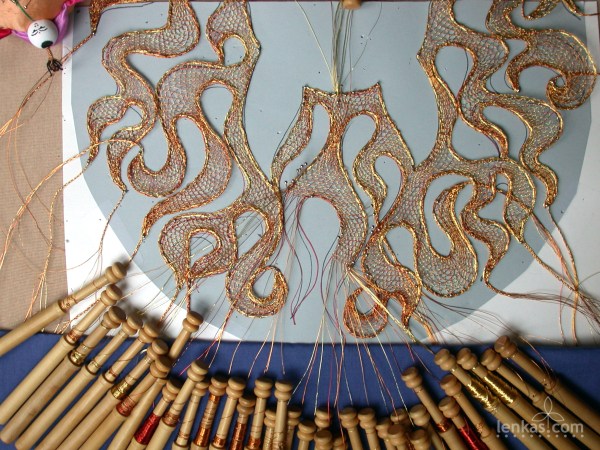
The second encounter with the Fire Horse came years later, when I was working on the third panel for the Venus Triptych, dedicated to the Divine Feminine manifestation through the fire element. In the ancient European mythology, the fire horse represented destruction and at the same time purification that prepares grounds for renewal. It was a very interesting project. Wire in multiple colours blended in a simple half stitch pattern, creating a fiery surge against the dark negative space. I still remember the intensity of the work so focused that it at times felt like being consumed by the flames. Interestingly, when the viewers look at the picture, they often see the flames, without noticing the horse. Once they realize it is there, they can’t take their eyes away from the fiery creature.


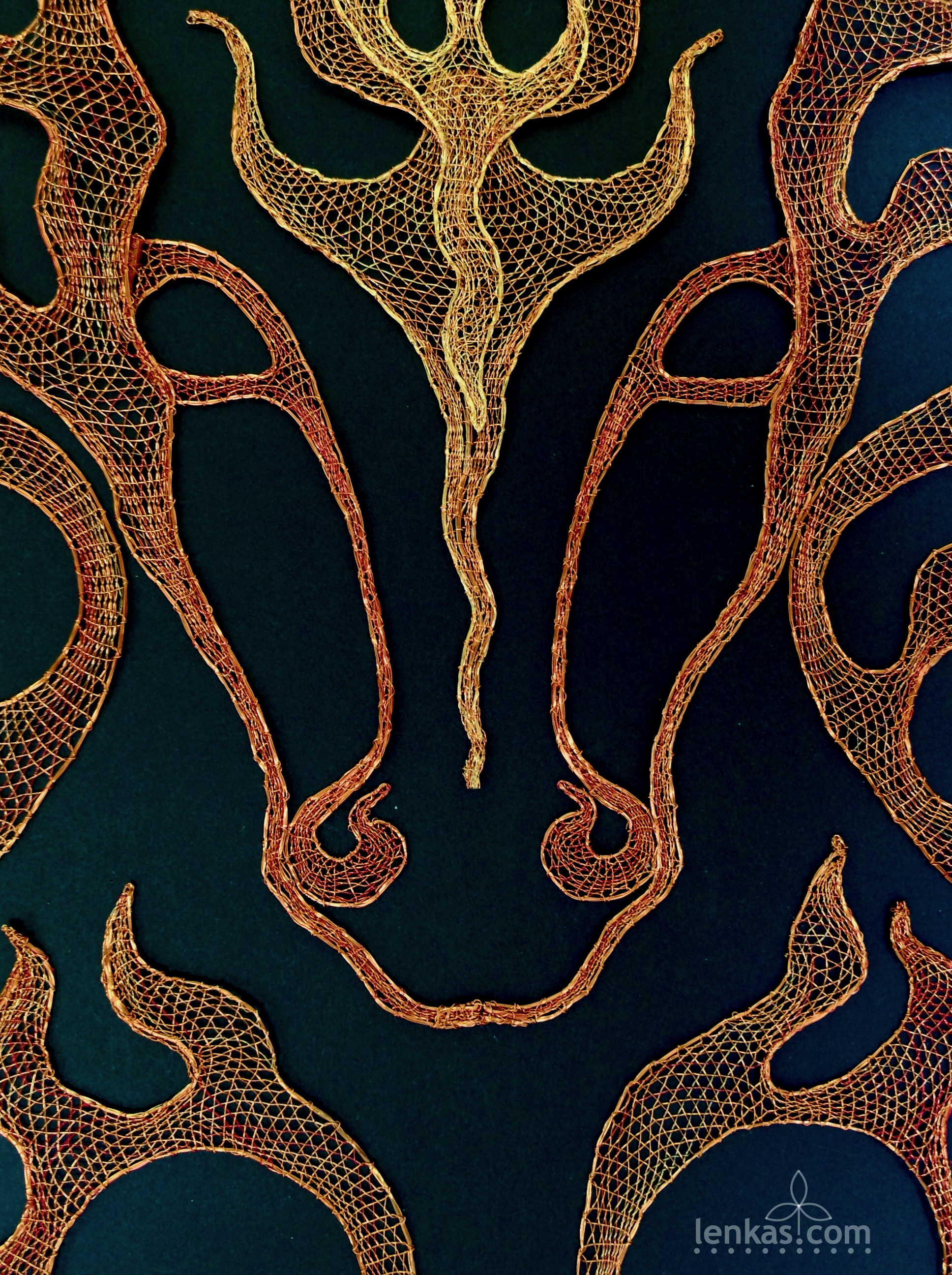
The third rendezvous is happening now: the Year of the Fire Horse just started and it will undoubtedly bring a lot of raw energy and many passionate moments. While the sheer power of the fire element in high speed motion might seem frightening, with the right intention and focus it can be harnessed to deliver profound transformations.
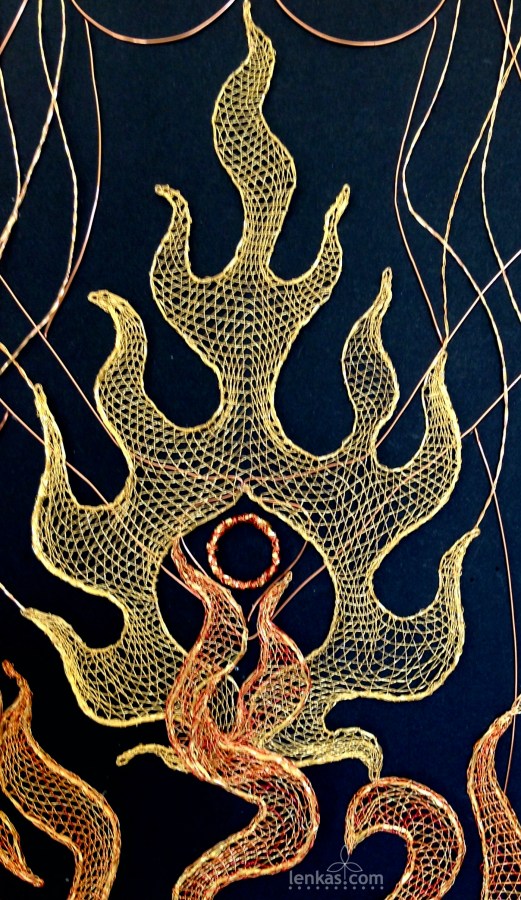
We are in for a wild ride !
Happy Birthday, Julia !!
And a happy, visionary and fertile year to all fearlessly creative artists, including the gentle but high-spirited lacemakers !!!
Winter Solstice 2025
Posted on December 21, 2025
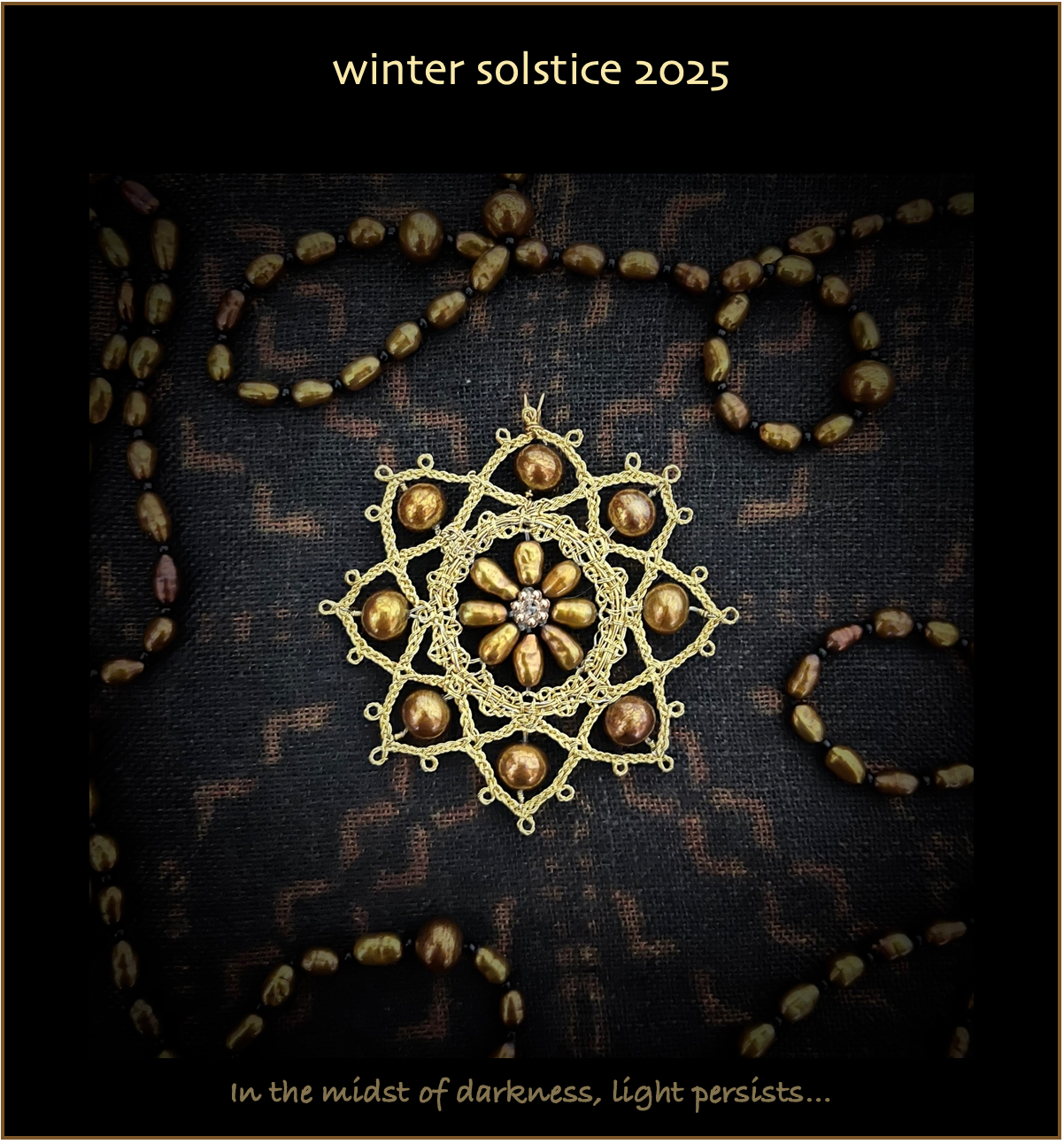
May the long nights of winter inspire enough lace projects for the entire year!
Wishing everybody a happy and creative time,
Lenka
In photo above:
Plaited lace Star Pendant in gold plated copper with fresh water pearls
Wire Lace Supplies Update
Posted on December 8, 2025
December 8, 2025
If you visited my Wire Lace Supplies on Etsy lately, you might have noticed that things are not as they used to be. Medium bobbins and kits are sold out, and wire stock is thinning. I am not replenishing the supplies, because it’s really hard to predict what is going to happen next.
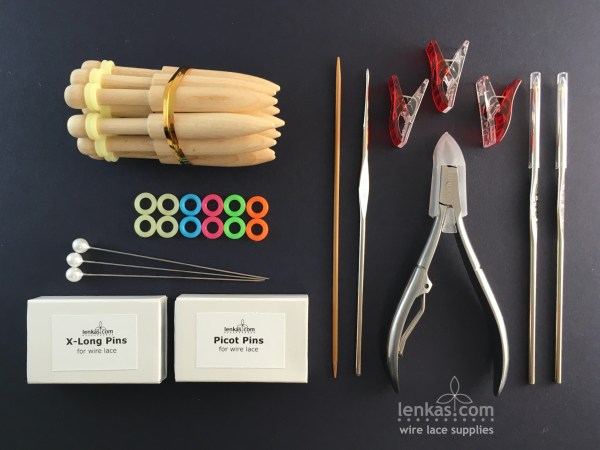
The shop stock count is accurate, and when the remaining bobbins and wires are gone, they are gone. I decided to take winter vacation and leave all business decisions until next year. Future will be perhaps a little bit clearer by then.

My lace studio is in Canada, a country that has been hard hit by the USA import tariffs. Canadian businesses depend heavily on US trade, and my craft studio is no exception. We live, work and create in a huge country that is sparsely populated, so our ability to sell to much bigger and stronger American market is very valuable. Unfortunately, this favourable condition no longer exists for small businesses in Canada.
Current paperwork requirements imposed on shipments from Canada to the USA far exceed the capacity of one-person operations. Besides that, 35-45% tariffs plus additional processing fees would likely double the prices for American customers. I had no choice but to suspend sales of tangible items (wires, bobbins and kits) to the USA. Sales decreased sharply even before the tariffs came into effect, which made my decision somewhat easier, knowing that with soft demand, not that many customers would be adversely affected.
Luckily, sales of digital downloads are exempted, so the Patters & Tutorials are available for everybody and at the same old price.

I don’t have anything against our southern neighbours doing what they need to do to protect and grow their domestic production. Canada would perhaps benefit from doing the same. Of course, specialty items like lacemaking bobbins can be imported from the traditional producers in Europe. But it would be nice to have a reliable source of basic stuff, like crochet hooks, pins, threads, wires, various tools, packaging materials etc, well-made right on this continent. And it would help a lot of small workshops like mine to keep traditional crafts alive. I find it quite alarming that from all supplies that I need to assemble and dispatch a simple beginner’s lacemaking kit, only one item – a cardboard box for shipping – is made in Canada! Everything else is sourced from many countries around the world. I think it would be nice to reach some sensible balance. Of course, this will take time, thirty years of globalization can’t be reversed overnight.
I have been running my lace studio in Canada for about the same time, and if I had learned anything, it’s a fact that nothing stays the same and change is the only constant in lacemaker’s life. At first, I created original works and exhibited them in places in Canada and around the world. Then I started to give instruction in wire lace. When teaching took over, I needed to provide tools and materials to my students, so I sourced the best wires, designed dedicated wire lace bobbins and made sure they were manufactured by the best bobbin maker in the world. Then came the lockdowns and shattered the teaching part of my business. Now the tariffs are about to shut down the Wire Lace Supplies. I guess, I will go with the flow and return to creating original lace works… let the new cycle begin!
I can’t really complain about that, because I love to design and make lace!

Reading the latest prediction by Elon Musk that “in 10 to 20 years, work will be optional and money will be irrelevant thanks to AI and robotics”, I am determined more than ever to preserve the fine craft of handmade bobbin lace.
Time will come when we will need to do something with our hands, otherwise we will go crazy.

Let’s keep lacing and creating!
Summer Solstice 2025
Posted on June 20, 2025
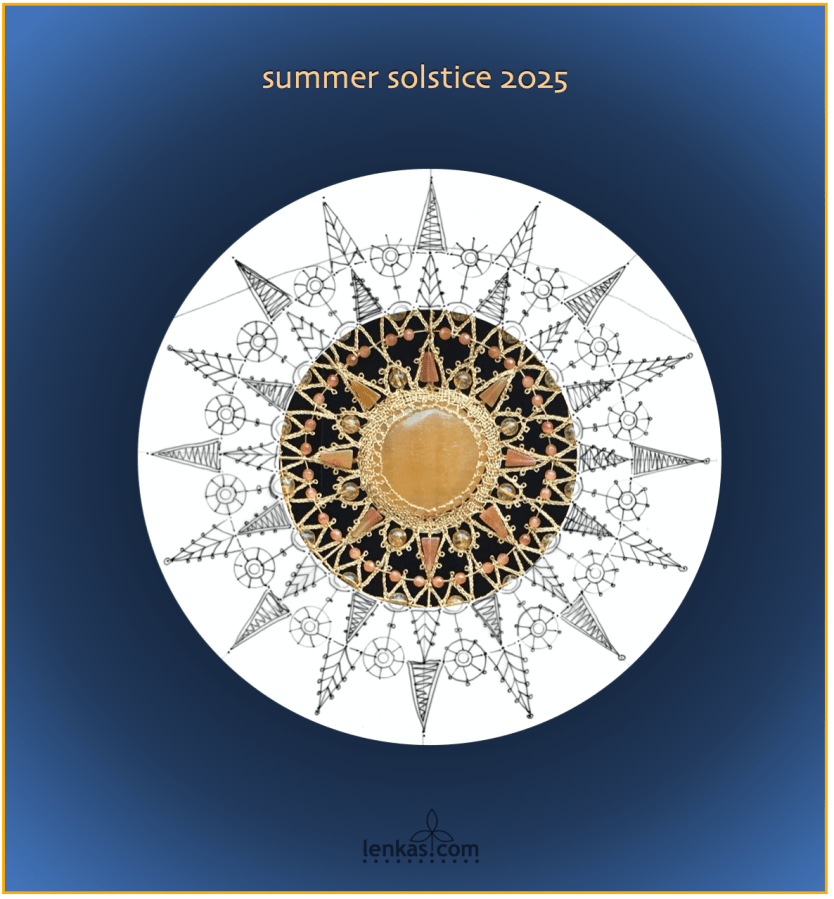
May the warm light of summer brighten our lacemaking pillows and illuminate all new lace projects!
Wishing everybody a happy and creative summer,
Lenka
Spring Chickens and Eggs
Posted on April 2, 2025
April 2, 2025
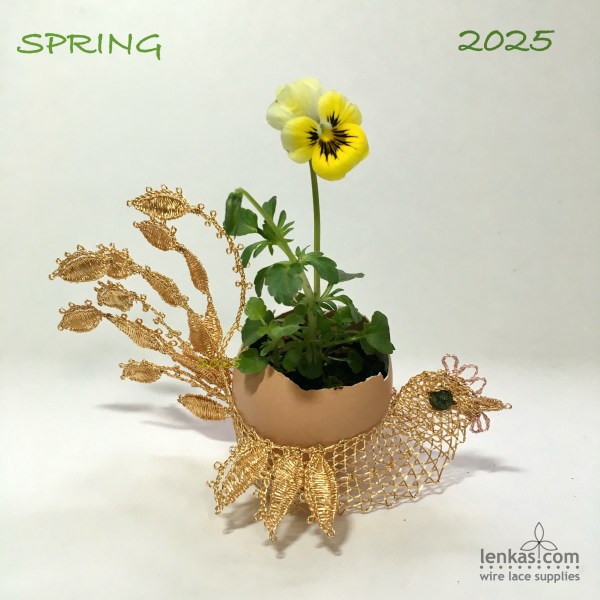
Spring has arrived and I feel like celebrating… sprouting, growing and blooming with plants, chirping and singing with birds, building nests and taking care of eggs… Chicken eggs in particular!
It must be my Slavic roots drawing me back to spring festivals of pagan tribes. In their spring rites, the eggs symbolized fertility, new life and abundance. Tradition of decorating eggs survived from ancient times through successive generations of girls who learned the delicate art from their mothers and grandmothers. Every region has a specific method – wax painting or resist dying, scratching, straw applications, perforating, and even wire wrapping – and there are as many original patterns as there are girls. Each saves the best egg for a boy that is close to her heart.
I think that’s one of the reason why this tradition is still alive. Love is perpetual!
Of course, I couldn’t resist the idea of decorating eggs with wire lace, bobbin and needle, and both techniques worked out beautifully. The small scale designs are fun to make for beginners and experienced lacemakers alike. I believe that Spring and Easter decorations are more meaningful when they are made by hand, especially when they are intended for special gift giving.
My favourite pattern is the Chicken Egg Stand because it holds a lot of creative potential for egg variations. While the stand remains the same, its content changes the overall decorative effect.
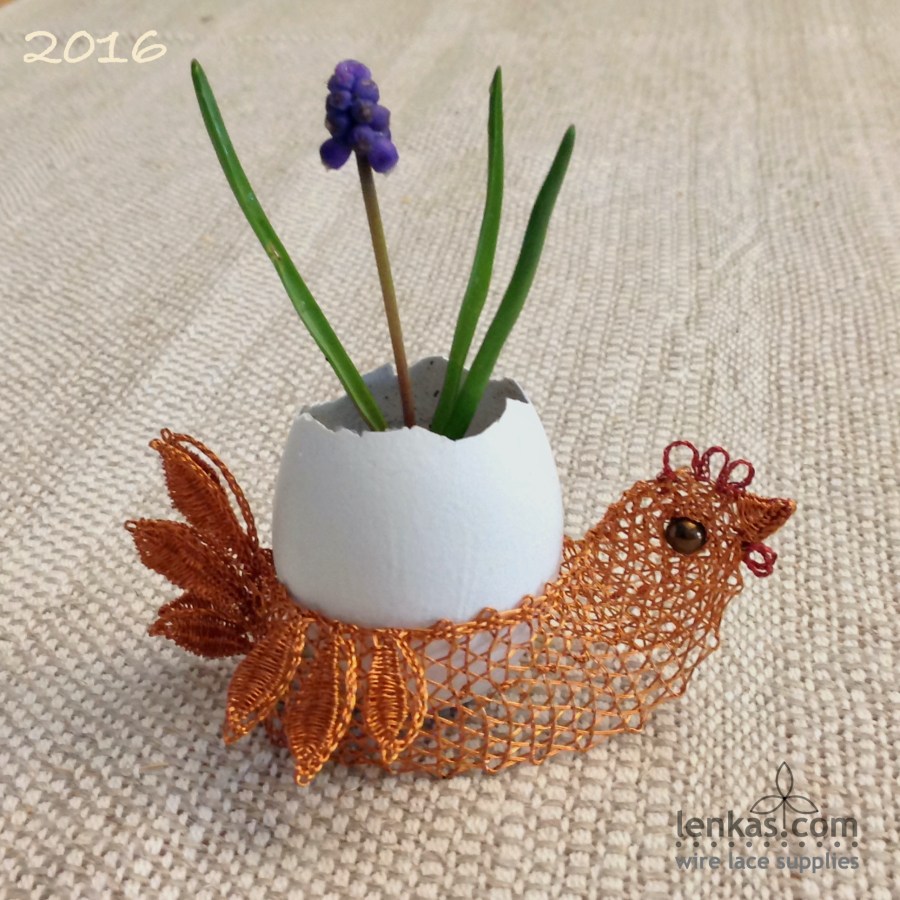
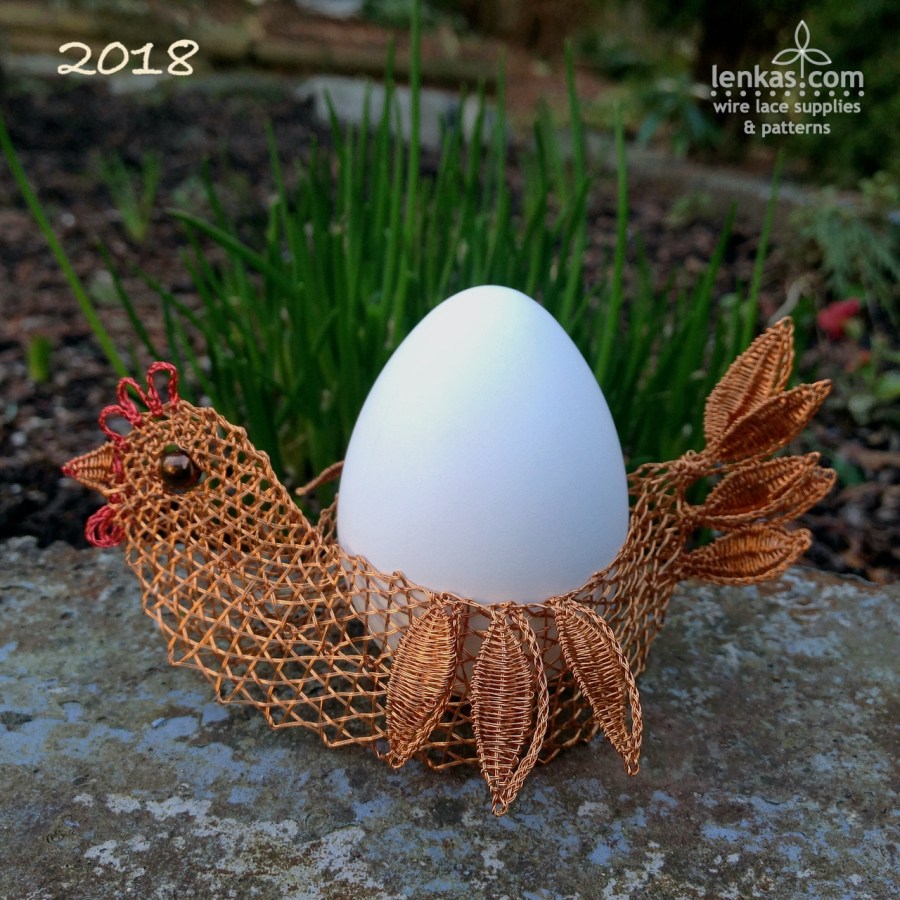

Every year my lace chickens are curious how their eggs will look like as we search in the garden to see what we find. This year it’s violas! So many self seeded all over the place and the tiny plants fit perfectly into hollow egg shells. Carefully transplanted, they look very cute in their miniature pots, sitting in the Chicken bases. It is fun to water them daily and wait for the flowers to open. What colours are they going to be?


One Chicken, a dark brown Buckeye, carries an oregano seedling for my friend’s new herb patch. For good luck!
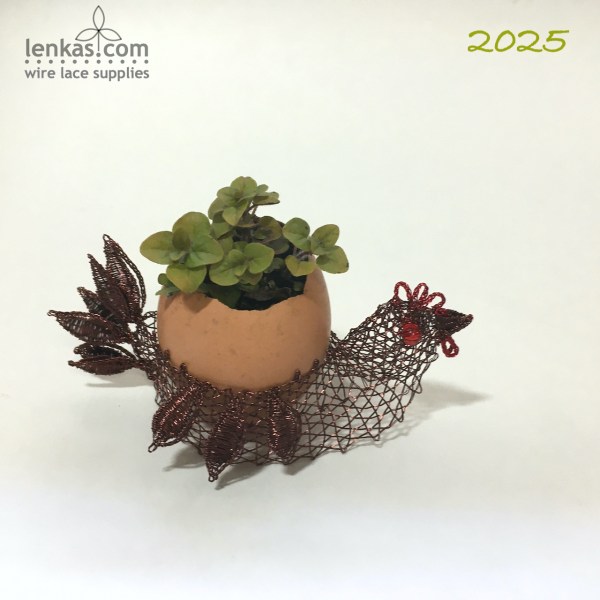
When the plants outgrow their temporary home they will be transferred to the outside pots or beds. The egg shells crushed to small pieces will released calcium carbonate and enrich the soil with essential elements. The plants will grow and blossom all summer long. Seedlings that won’t get transplanted will be composted, so there will be no waste. Mother Nature will be pleased.
The lace chickens will then return to their envelope to rest until next year. Unlike my other Spring/Easter decorations they store flat, taking up hardly any space.
I am so glad to have them, we enjoy each other’s company during all lovely festivities, spring after spring!

Over the years, I designed more lace egg decorations, mostly as workshop projects, and I see potential for many more.
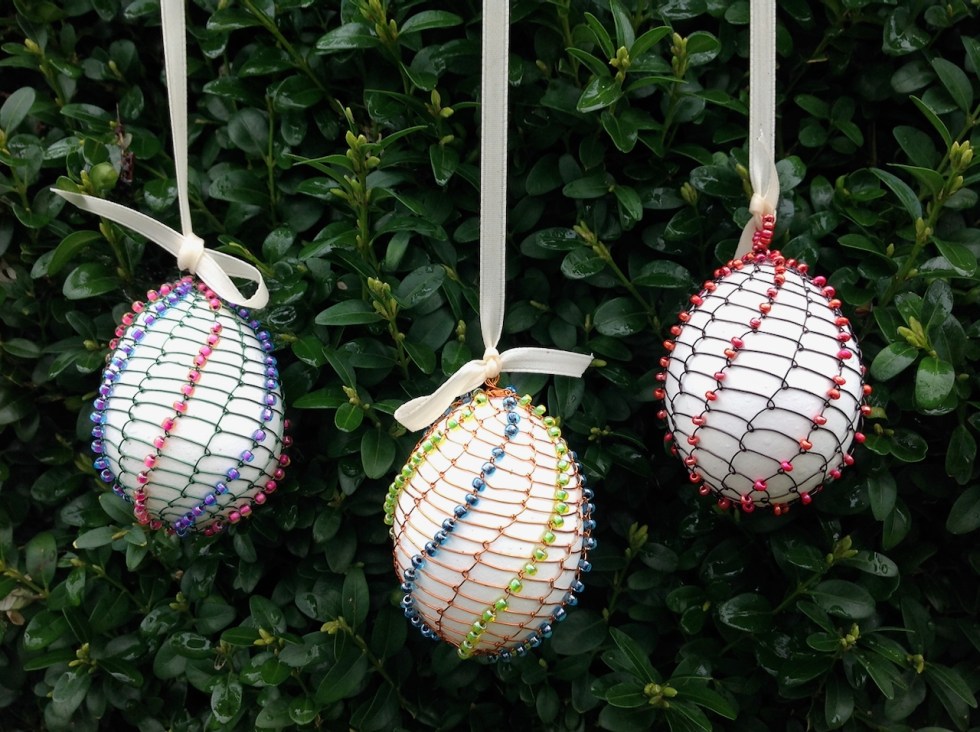
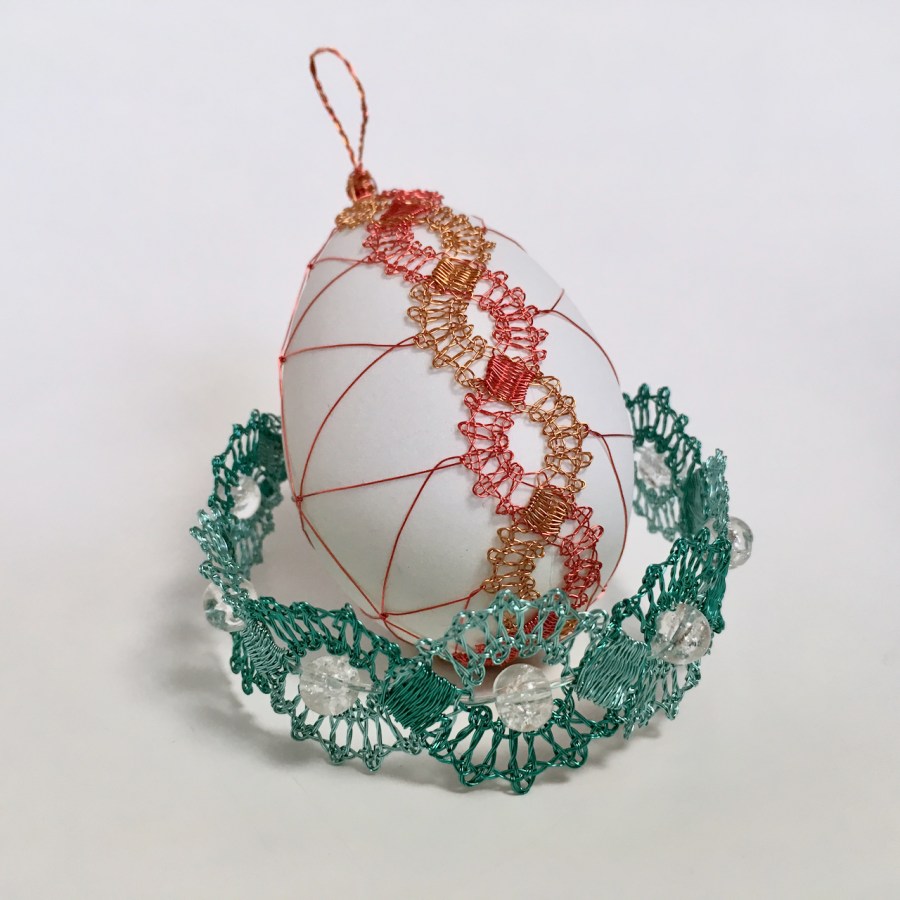
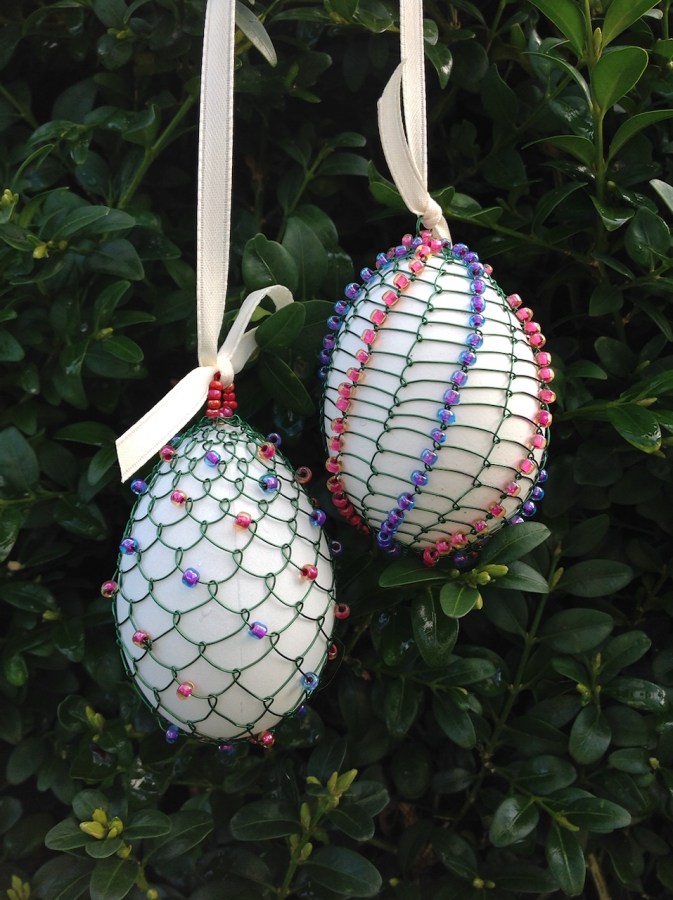

But sometimes I feel that my “eggthusiasm” is a bit displaced. After all, I have lived in a different part of the world for a long time. Maybe I should start to think about lacy Easter Bunnies 🙂
Cheers to all creative spring ideas, wherever and however they manifest!
Lenka
Year of the Snake
Posted on January 28, 2025
January 29, 2025

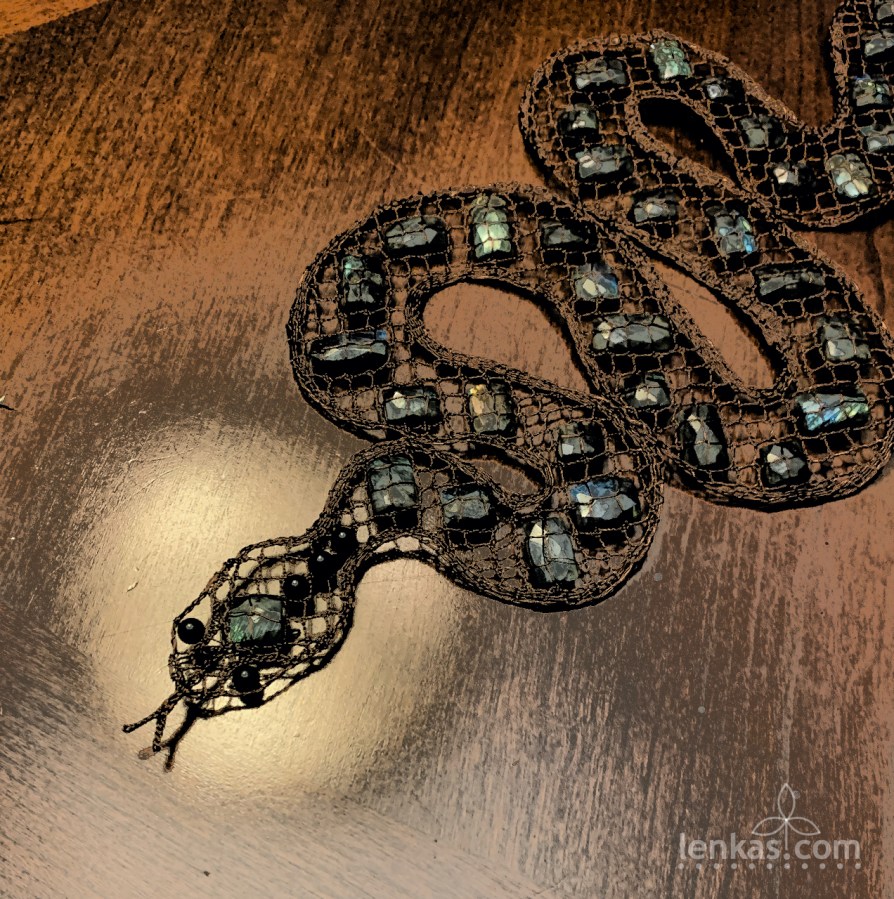
Snake in enamelled copper with labradorite stones – tape lace with torchon ground filling.


Serendipitous Wire Test
Posted on November 19, 2024
November 19, 2024
I like to say that wire lace is forever. It is true, because wire is much stronger than threads and deteriorates slowly. But when some of my metal lace creation changed colour over time I realized that longevity of wire coating might be uncertain.
Craft copper wire is coated with a layer of material that protects the raw metal and gives wire its colour. When the coating is not completely sealed the air reaches wire beneath and reacts with it in a natural chemical process. In case of outside copper and bronze sculptures, it is expected and accepted that the tarnish will eventually deposit and permanently colour the artwork. But it is much harder to surrender our delicate lace art to natural forces. We know what happened to antique metallic laces when they lost their lustre…
The first copper wires I used for making lace were from magnet coils found in old electrical appliances. They were durable, made to withstand harsh conditions of various environments. Despite being fifty-sixty years old the spools of wire looked like new. Old enamelled wires were of excellent quality, made to last, but the choice of colours was limited. Many of my works were created in the typical colour range of reds, yellows and browns, with occasionally green. It was fine at the beginning, when I welcomed any wire for my lace, but then of course I started to dream about blues, turquoise and purples…
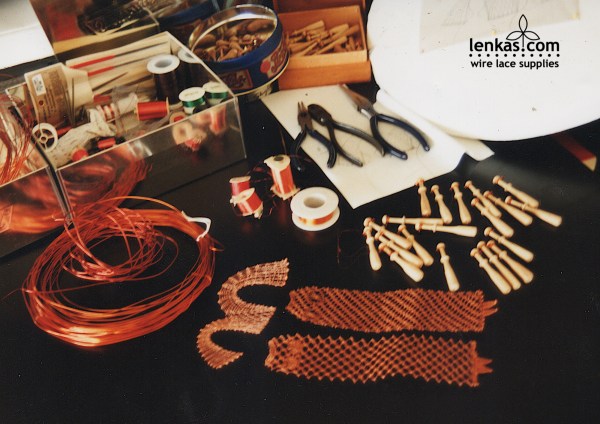
Luckily, I was not alone searching for coloured copper. There was a growing demand from other artisans and artists – knitters, weavers and crochetiers (and zealous fly tyers). Right at that time some manufacturers, looking to find alternative markets, started to produce wire for craft field. It was not an easy task to satisfy the needs of creative people who wanted soft, pliable wire in lots of colours. New products were tested with mixed outcomes. The coating was posing the biggest challenge; often it was weak and chipped or peeled off during work. Sometimes the wires worked fine, but the colours were unstable and turned dull and grey really quickly. It was time of trial and error but finally a handful of manufacturers were able to produce reasonably stable coloured copper wire. I still have some works from those times, still in good condition, aging gracefully as their colours are slowly fading. And now, many years later, I have a better understanding of the process.
Eventually, I found good quality wires for lacemaking, and I consider myself lucky to be able to work with material that is worthy of such time-consuming and labour-intensive craft as bobbin lace. Over time, “my” manufacturer produced many beautiful colours while keeping or exceeding the quality standard.
About two years ago, I noticed the wire changed. Being too small a customer, I do not get informed about product modifications, but I could see and feel the difference in the new spools. The colours were richer and brighter and the wire felt just a tiny bit harder, springier. Based on my experience, I deduced that the coating technique changed to produce brighter hues, and I trusted that the surface quality improved as well. I tried a few simple chemical tests with satisfactory results, and left it at that. Time will tell.

And soon enough, it did. This year, when I was working in my front yard, trimming back a pachysandra border, I noticed bright sparkle in the depth of the bundled stems. I reached in and pulled out two spools of wire, silver plated and bright pink colour. They looked like they have been there for a while, because the spools were all dirty. and wet. But the colours were still brilliant!
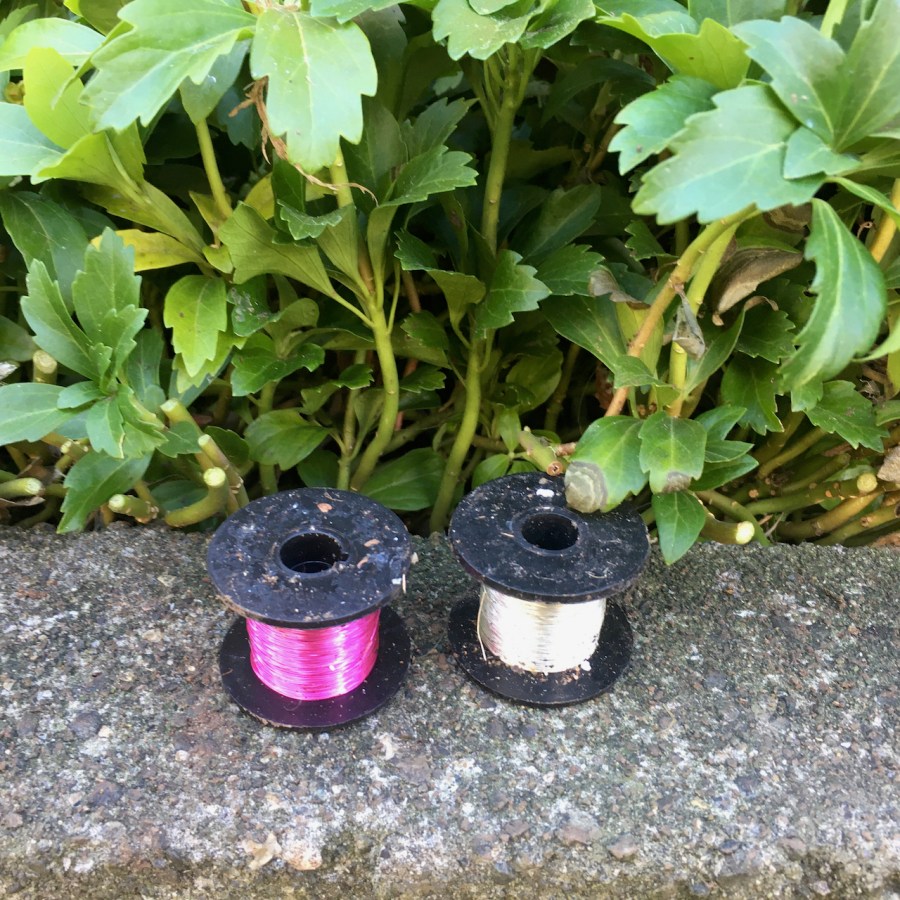

How did the copper wire spools end up in the vegetation?
With each new product I need photos for my online shop. Because the shiny wires are difficult to photograph in artificial light, I have the best chance to capture true-to-colour images in muted natural daylight on a cloudy day. So I usually set up the photo station on a landing in front of the house. After a photoshoot on one of those perfect grey days, two runaway spools did not make it back home. They must have slipped over the edge of the landing and descended into pachysandra’s embrace. I did not notice them missing and they stayed there… for a very long time. The wire was exposed to outside elements – a lot of moisture during rainy season, followed by dry summer heat (but not direct sunlight), steady ocean air breeze, rain again, and cold, including extreme freeze (for the West Coast of Canada anyway) of minus fifteen degrees Celsius for almost a week. Even the pachysandra, a tough plant that normally tolerates our weather without complaining, showed some frost damage after the winter.
Surprisingly, the two spools of enamelled copper wire survived intact. I cleaned them and they look like new. A very impressive result of the unplanned test, and a proof that the quality of these wires is indeed excellent! Their coating’s ability to protect the colour is especially significant in the case of the silver plated wire. Silver readily tarnishes when exposed to moisture, and would turn black quickly if the surface was not perfectly sealed.
Now I have a proof that the silver-plated copper wire is truly non-tarnishing! And I am very happy to know that with this material our wire laceworks have a real chance to be forever 🙂
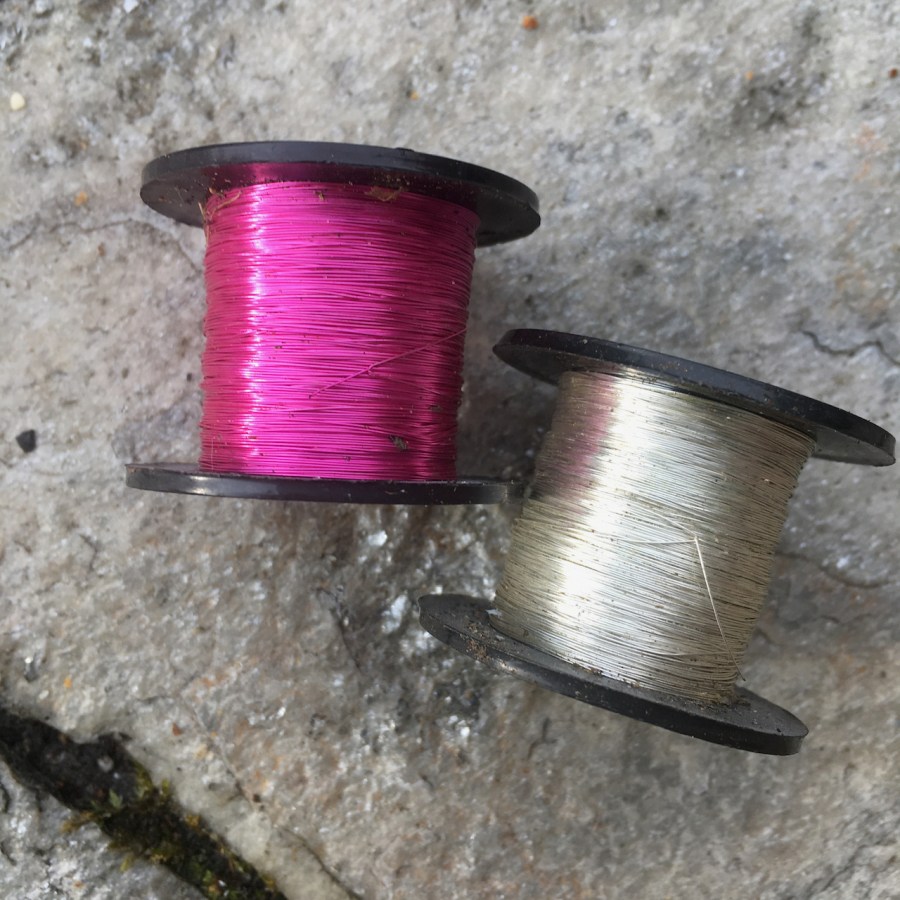
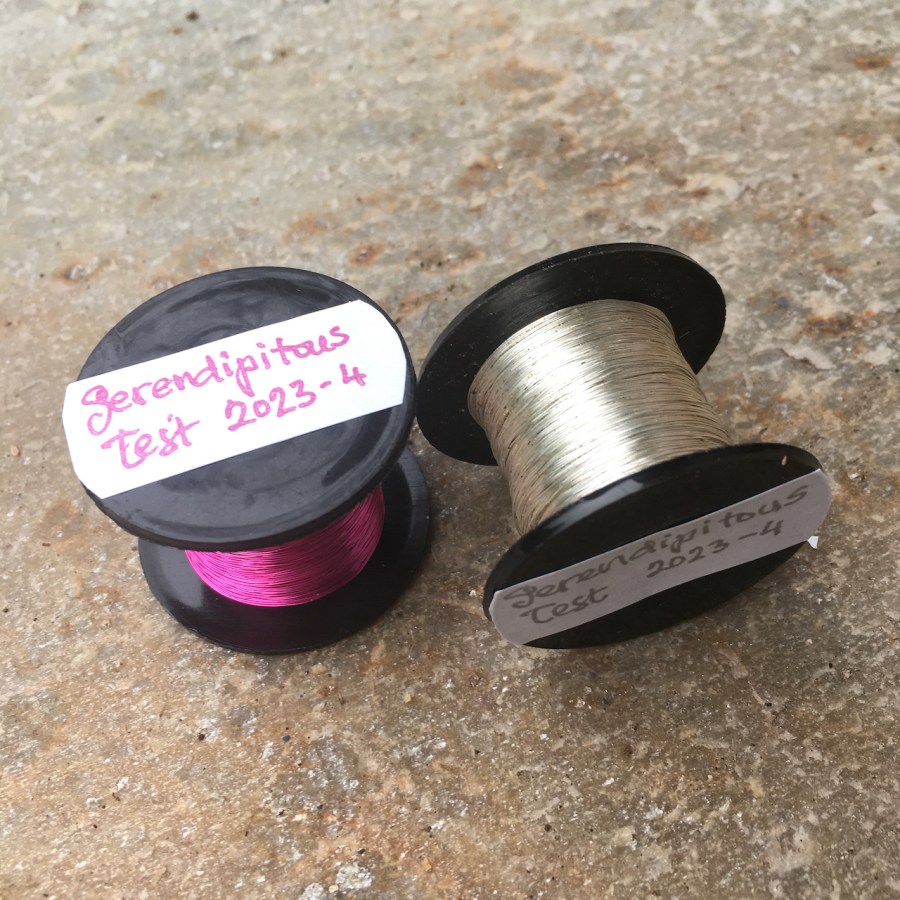
Remember to treat the wire gently to keep the surface whole and prevent scratches by pins, sewing hooks and nudge tools. With proper care your wire lace will shine and sparkle for years to come.
Both lost and found spools are now back in my studio. I will not sell them, of course, they stay in my wire box for future observation. They join other spools in my collection of miss-shaped, mislabeled and miss-wound spools. Eventually the wire will complete its uncommon journey and become a piece of unique lace.

Just in time for a merry crafting season, WireLaceSupplies shop is stocked with wire in every colour for all your creative needs 🙂
Happy lacemaking, and lacemaking with wire especially!
Lenka
PS: Before I finished writing this post, I already started working on a new project with the mentioned silver wire. Next post is coming soon!
Wire Lace Supplies Restocked
Posted on October 28, 2024
October 28, 2024
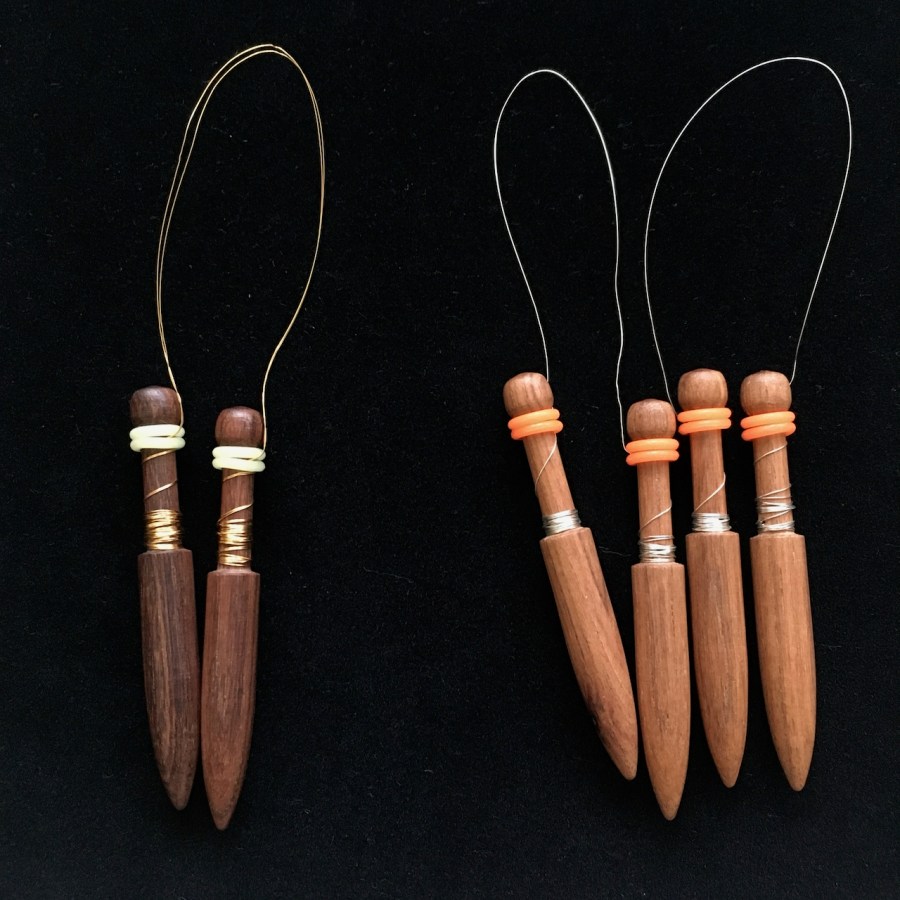
After a short wait, the wire lace kits are back.
I am happy that I was able to restock them just in time for a busy crafting season.

Since the supply chain disruption it has been more difficult to bring all parts for the kits together. Notions that used to be a haberdashery staple now disappear without warning, and those still available can become prohibitively expensive. “Dynamic Pricing Algorithms”, I am told, is the reason: if a product is scarce its price goes up.
I think that’s not the best news for lacemakers in North America. Fine craft of lace has always been rare in the New World. Limited demand from a small dedicated group did not give grounds for mass production of tools and materials on the continent. Yet lacemakers in Canada and USA were always able to find what they needed for their craft, through imports and by sourcing from local cottage industry. If what I see now indicates the future development, the unique lacemaking kits will reach such prices that only the richest people will be able to afford them. And maybe one day, a successful cyber space entrepreneur who made fortune selling the algorithms, will buy the last kit and take it to Mars to save bobbin lace, together with human consciousness, from obliteration… or maybe not?
I hope that these new business models will eventually deliver a positive change. I don’t know, I have never invested enough time to understand the market forces and the science of selling. Rather I have perceived my small lace supplies business as a service to the lacemaking community. In thirty years I taught the craft to many people and supplied the equipment and materials to many more with the goal of keeping the craft alive, thriving and evolving. I believe that tools for beginners should be of good quality and reasonable price to make the craft widely accessible and open to newcomers from every walk of life. Because lacemaking belongs to us, on this Earth, and we don’t know where the next brilliant lace designers or artists might come from.
Till today, I pack each lacemaking kit with care and send it off with a sincere wish to serve well and bring joy to another creative lacemaker in our small but dedicated group 🙂
Happy lacemaking to everyone!

Please visit my Wire Lace Supplies on Etsy to see all tools, materials and patterns!
Quintet of Old Wise Trees from Stratton Lace Makers in the United Kingdom
Posted on October 14, 2024

October 14, 2024
It’s always a special day when an Old Wise Tree photo reaches my email inbox. When five of them come together, it’s a celebration! I love to see interpretation of the pattern and never fail to be impressed with lacemakers’ imagination, creativity and skills.
Recent arrival of an Old Wise Tree quintet from Stratton Lace Makers in Dorset, UK, couldn’t have come at better time. Summer in Vancouver, Canada, was ending, and because it was short and mild, I did not feel quite ready for change of seasons. The collection of the Old Wise Trees from Dorset reminded me that trees are beautiful in every season, from spring to winter, as they follow the wisdom of Nature’s cycle without resistance. That was exactly what I needed to realize in order to welcome autumnal equinox with poise and embrace the upcoming fall.
Besides communicating a positive massage trough their art, the Stratton lace makers fulfilled another goal of the Old Wise Tree project: working as a group they contributed to keeping lacemaking alive in communities. As a self-taught lacemaker I experienced limits of learning the craft in isolation, and therefore, throughout my lacemaking career, I initiated many projects for groups. I watched with great satisfaction how well lacemakers learned together, how they encouraged and helped each other, overcame obstacles and shared success. I believe that this bond is inherent to textile crafts, and lacemaking wouldn’t have grown as fast and lasted as long without it. By carrying on the fine craft tradition, together we belong to the same time-honoured family tree. The first Old Wise Trees were created with my pupils in the New School of Lace classes, and when the Old Wise Tree moved online, I hoped that more lace groups will find it.
Gillian Membury, who organized the Old Wise Tree project for Stratton Lace Makers, wrote:
“It was a fun project to complete as a group as we watched each tree grow and develop. We all agreed that the most difficult part was getting the roots to lie in a tidy way!”
I agree – the roots are the biggest challenge! And it is because the way how the roots are made in the Old Wise Tree is an antithesis to bobbin lace.
Lacemakers love patterns. We are all attracted to geometrical grids of dots and complex system of twists and crosses. We love our very orderly bobbins which keep our threads tidy. Within the structure, no matter how complicated, we can lead multitude of threads to successful completion of an intricate pattern. But when it comes to loose threads, we seem to get lost. That’s exactly where lies the test of the Old Wise Tree: the root work takes us to uncharted territory. We have to step out of the lacemaker’s mind, let go of an idea of a perfect order and work with unbound threads. At first, it is uncomfortable, confusing, even bewildering, but as soon as we give up control the roots start to flow and find their place. The finished tree brings a big relief and a sense of accomplishment, earned through the difficult underground journey.
And then, when we return to our beloved bobbin lace we enjoy our perfect patterns and charming sound of clicking bobbins more than ever before.
When I designed the Old Wise Tree, of course I did not mean to torment myself, let alone other gentle people. I just thought that the contrast between orderliness of the crown and disorder of the roots is interesting and that side-by-side comparison draws attention to the intricate bobbin lace weave. Many non-lacemakers find the Old Wise Tree intriguing, and want to know more about the technique. And for the lacemakers, the pattern opens door to experimenting and trying something different. The challenge is such that only the strongest individuals succeed!
Please allow me to introduce five of them – Stratton Lace Makers- from Dorset in the United Kingdom :
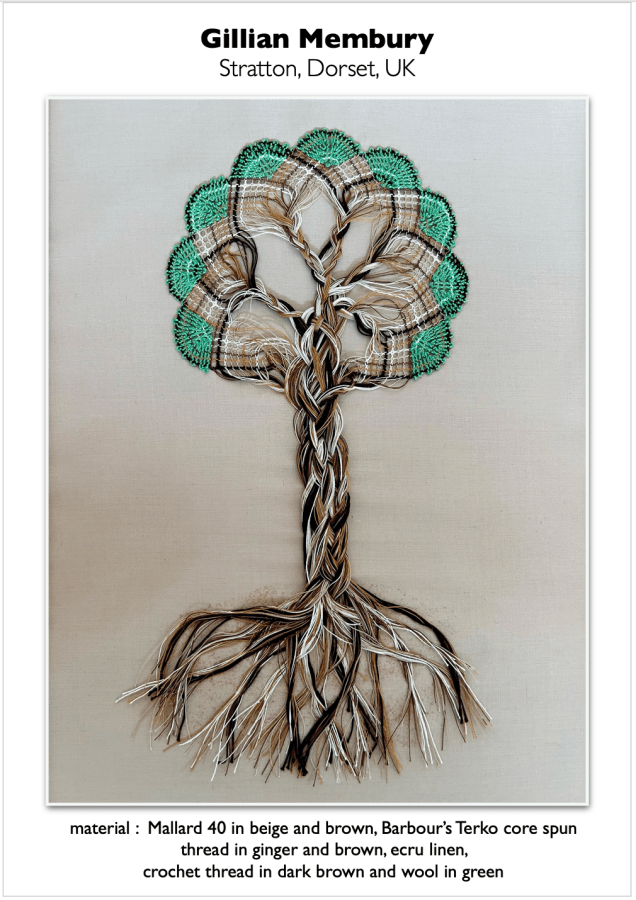
Gillian’s Old Wise Tree reminds of early spring, with fresh and soft green crown growing from branches that look as if covered with morning frost. Contrasting colours of threads in variety of materials add a lot of interest to the crown and accentuate the branches and imaginatively braided trunk. The strong tree is supported by equally strong roots which indicate future vigorous growth. Well made and very unique Old Wise Tree!

Anthea’s choice of colours evoke dream-like atmosphere of late spring-early summer season. Interestingly, a variety of effects in this work was achieved with just one size of thread (Finca Cotton #40). The threads in mixed colours flow from vast and delicate root system up through the trunk and branches, blending to achieve watercolour-like softness and movement. In juxtaposition, two strong colours that boldly define the crown remind of a palette knife painting technique, a perfect choice for portraying robust and vigorous foliage. In Anthea’s work the soft and subtle merges with strong and powerful, and it is evident that lace art can express both aspects of nature equally well.
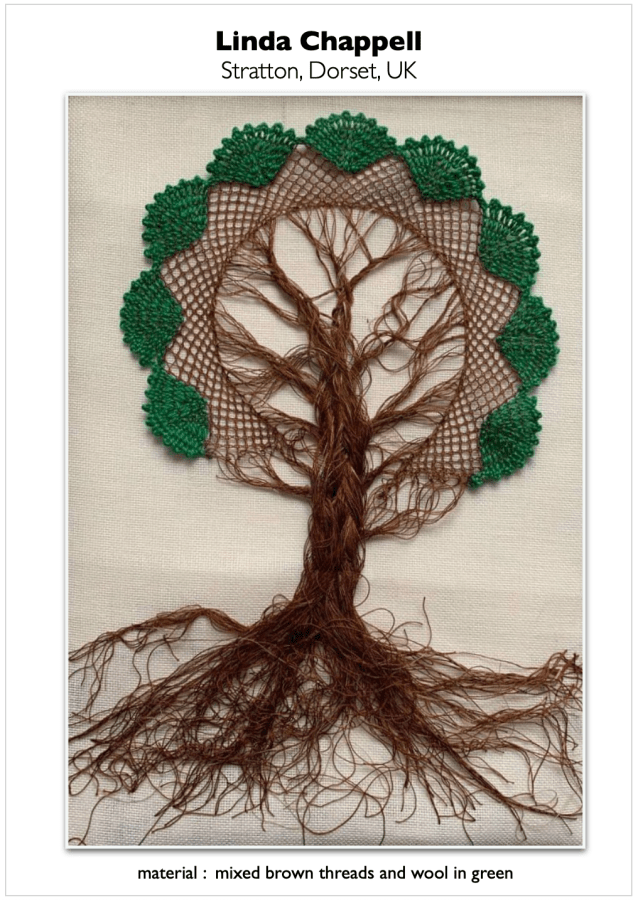
As a prime example of the design challenge that I explained above, Linda’s Old Wise Tree aptly illustrates the pattern dilemma. Her flawlessly executed bobbin lace Torchon ground in the crown stands out against free, organic body of the tree. Linda emphasized the ground with added footside as if to point out the pattern’s connection to traditional doilies. The concentric line clearly separates lace part from freely formed branches, trunk and roots. As the threads leave the pattern to bundle and braid, their texture and subtle colouring becomes more prominent until it takes on almost organic feel of a tree bark. Linda’s artistic approach to the tree foundation is open and relaxed and the roots are unapologetically wild – bundled, knotted, gnarled – and free. A truly unique Old Wise Tree!
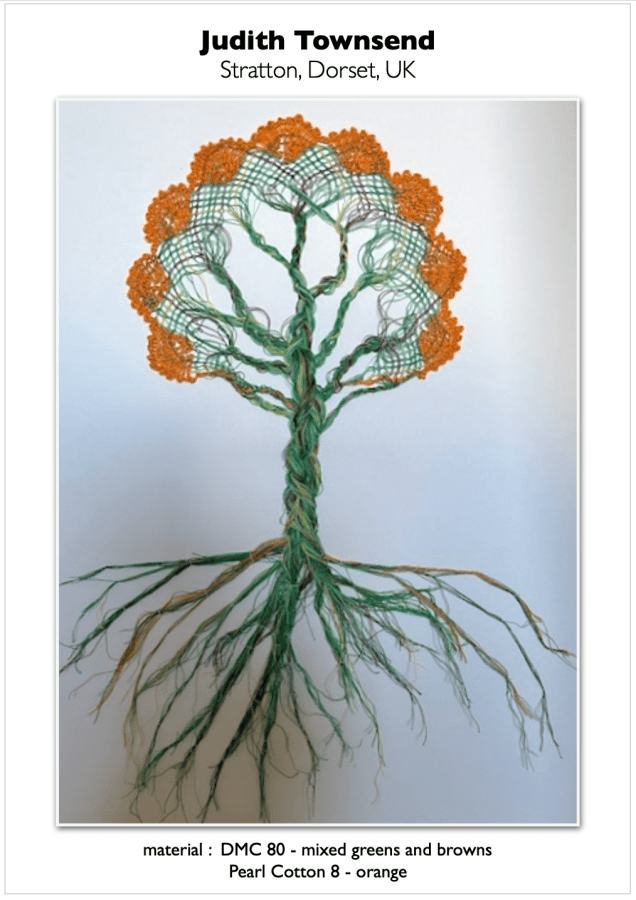
It was Judith’s Old Wise Tree with its cheerful tall crown that reminded me about the autumnal beauty. Threads in lively greens with brown accents create a fun pattern in the crown and add depth to braided branches and trunk. Pearl Cotton in bright orange fills the crown with gorgeous display of carotenoids and the tree seems to be dancing with joy in its new dress. Interplay of colours between the leaves, branches, trunk and deep roots calls to mind the way that real trees move water through their entire system and distribute nutrients for healthy growth. And by the way, just as a byproduct, supply oxygen for all aerobic creatures on this planet… Trees are simply amazing!
And Judith’s Old Wise Tree is a tribute to their beauty, vivacity and generosity.

Anette’s Old Wise Tree looks like a majestic oak at the beginning of winter. Its strong and sturdy wide-spread crown is supported by muscular brunches growing from a well built trunk. Underground root system shows the same robustness and resolve to grow to its fullest potential. Anette’s choice of threads greatly contributes to a successful portrait of this handsome tree. Linen, metallics and polyester mix delivers lovely tones and shading with subtle sheen. It was probably not easy to work with such variety of materials simultaneously, but it produced very good effect in Torchon ground and excellent volume in the rest of the tree, especially in the trunk. Dark pearls randomly distributed throughout the crown added a sparkle that contributes to a royal look of this Old Wise Tree.
What a wonderful journey through seasons! Thank you, Stratton Lace Makers, for sharing your original lace creations. Your quintet of Old Wise Trees makes a truly special addition to the Old Wise Tree Online Gallery!
I invite everybody to visit the Gallery to view the new works together with others, thirty seven Old Wise Trees in total. If you perused the online gallery before, this time please remember to pay close attention not just to the beautiful tree crowns, but also to the amazing roots!
With thanks,
Lenka
The Free Old Wise Tree Pattern and Tutorial was published on this website on January 16th, 2021.
As of October Oct 1st, 2024
- the page has been viewed 14,406 times
- 2904 visitors downloaded the pricking
- 37 artworks from 8 countries have been submitted to be exhibited in the Old Wise Tree Gallery
Together we are slowly growing an Old Wise Grove. Big thanks and a round of applause to all participating lacemakers!
Are there more lace trees growing in the world?
Please consider reaching out by sending a photo of your tree with following information to this email address:
Your Name + City / Country + Materials used + Pricking size (if different than the original 100%)
+ Optional: Notes (any specific information you would like to add)
**************************************************************************
Disclaimer: By submitting the photo/s and requested information you agree that your work will be displayed in the Old Wise Tree Gallery hosted on this website.
**************************************************************************
Summer Solstice 2024
Posted on June 21, 2024

June 21, 2024
Summer Solstice yesterday and full moon tonight – what an alignment of energies!
After the spring creative surge, summer will rely on feminine strength to nurture all living things, raise the young, bear the fruits, collect the harvest… and complete visionary projects. As every year, Mother Nature and all her daughters will fulfill these enormous tasks with love and kindness.
In times of information overload it’s easy to overlook or even forget life basics. In the same way it is almost impossible to focus on fine detail of delicate handmade lace in the midst of deluge of AI generated images. But it really is just a matter of perception.
May the summer season bring clarity and vivacity to sustain the balance, and divine inspiration to find the way.
Happy lacemaking to all!
Lenka
PS: The photo above is from Summer Solstice celebrations in my first studio in Vancouver, Canada, in June 2004. It features wearable lace made with gold plated copper and semiprecious stones. The world has changed a lot in last twenty years, but the possibility for love – and creative lace – remains the same.
 Lenka's Way of Lace